What happens when a growing movement hits its first major controversy? It either fractures—or finds clarity.
Acts 15–22 shows us a Church maturing under pressure. Doctrinal disputes arise. Missionary journeys intensify. Riots erupt. Leaders are beaten, arrested, and misunderstood. Yet through it all, the Gospel advances with remarkable resilience.
If Acts 1–14 was about expansion, Acts 15–22 is about endurance. Let’s walk through these pivotal chapters and uncover what they teach us about faith in the real world.
Acts 15: The Dispute That Defined the Gospel
Every growing movement eventually faces a defining question.
In Acts 15, certain believers insist that Gentile converts must be circumcised and follow the Law of Moses to be saved. The issue threatens unity and clarity.
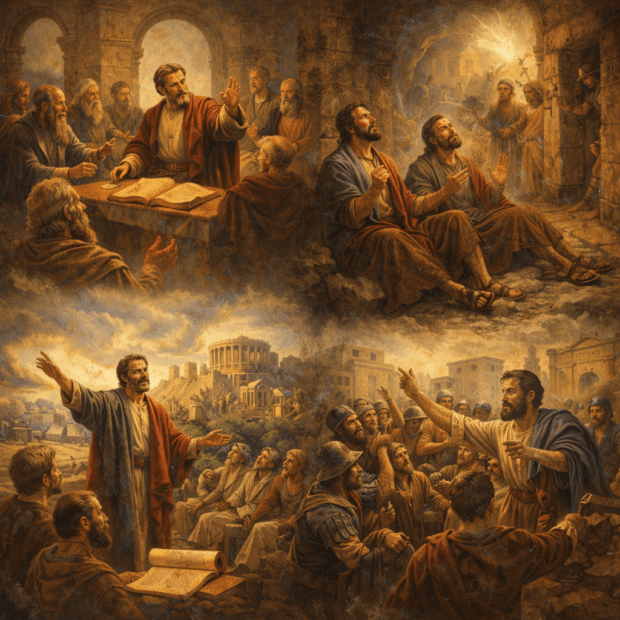
The apostles and elders gather in Jerusalem to address the matter—what we often call the Jerusalem Council. After discussion, Peter stands and reminds them that God gave the Holy Spirit to Gentiles just as He did to Jews. James affirms that salvation is by grace, not by the burden of the law.
Their conclusion preserves the heart of the Gospel: salvation comes through the grace of the Lord Jesus Christ.
The importance of doctrinal clarity cannot be overstated. A 2022 Ligonier Ministries survey found that confusion about core Christian doctrines remains widespread among churchgoers today.
As theologian R.C. Sproul once said, “Right theology leads to right living.”
Practical Tip: Know what you believe and why. A clear understanding of the Gospel protects unity and strengthens faith.

Acts 16: Worship in the Midnight Hour
What do you do when obedience lands you in prison?
Paul and Silas travel to Philippi during Paul’s second missionary journey. They encounter Lydia, whose heart the Lord opens to the message. But after casting a spirit out of a slave girl, they are beaten and imprisoned.
Instead of despairing, they pray and sing hymns at midnight. Suddenly, an earthquake shakes the prison. Doors open. Chains fall off. The jailer, terrified, asks, “What must I do to be saved?”
Paul responds:
“Believe on the Lord Jesus Christ, and thou shalt be saved…” (Acts 16:31, KJV)
Research published in the Journal of Positive Psychology shows that gratitude and worship practices increase resilience under stress. Paul and Silas embodied that truth long before modern studies.
Charles Spurgeon said, “Any fool can sing in the day. It is easy to sing when we can read the notes by daylight.”
Practical Tip: When circumstances darken, let worship become your weapon.
Acts 17: Faith in the Marketplace of Ideas
Can the Gospel stand in intellectual arenas? Absolutely.
In Thessalonica and Berea, Paul reasons from the Scriptures. The Bereans are praised because they search the Scriptures daily to verify his teaching.
In Athens, Paul addresses philosophers at Mars Hill. He connects the Gospel to their culture, referencing their altar “To the Unknown God” and even quoting their poets.
A study from the Barna Group shows that younger generations are especially drawn to thoughtful, reasoned discussions of faith.
C.S. Lewis wrote, “Christianity, if false, is of no importance, and if true, of infinite importance.”
Practical Tip: Be prepared to explain your faith thoughtfully. Study Scripture and engage culture with wisdom.
Acts 18: Strengthened Through Partnership
No one fulfills God’s mission alone.
In Corinth, Paul meets Aquila and Priscilla, fellow tentmakers who become ministry partners. He preaches in the synagogue and later focuses on Gentiles after opposition increases.
The Lord reassures Paul in a vision: “Be not afraid… for I am with thee.” (Acts 18:9–10, KJV)
Leadership research consistently emphasizes the power of collaborative partnerships in sustaining long-term impact.
Helen Keller once said, “Alone we can do so little; together we can do so much.”
Practical Tip: Build strong partnerships in your faith journey. Community strengthens calling.
Acts 19: Power That Confronts Darkness
When truth enters a city steeped in idolatry, tension rises.
In Ephesus, Paul teaches daily for two years. Extraordinary miracles occur. Many who practiced magic publicly burn their scrolls—costly acts of repentance.
The Gospel disrupts the local economy built around the worship of Artemis. A riot erupts, led by a silversmith named Demetrius.
According to sociological studies, religious movements often face strongest resistance when they challenge economic or cultural norms.
Martin Luther once said, “Peace if possible, truth at all costs.”
Practical Tip: Expect resistance when your faith challenges cultural systems. Stay grounded in truth.
Acts 20: Shepherding with Tears
Leadership is not just about preaching—it is about caring.
Paul gathers the Ephesian elders and delivers a heartfelt farewell. He warns them about future challenges and urges vigilance.
He reminds them:
“It is more blessed to give than to receive.” (Acts 20:35, KJV)
Research in leadership psychology shows that servant leadership fosters deeper trust and long-term influence.
John Maxwell states, “A leader is one who knows the way, goes the way, and shows the way.”
Practical Tip: Lead with humility and generosity. Influence grows when service comes first.
Acts 21–22: Standing Firm in the Storm
Obedience sometimes leads directly into hardship.
Despite warnings, Paul travels to Jerusalem. Rumors spread that he teaches against Jewish customs. A mob forms. He is seized, beaten, and nearly killed before Roman soldiers intervene.
In Acts 22, Paul addresses the crowd, sharing his personal testimony—including his dramatic conversion.
Studies in communication psychology show that personal testimony often carries more persuasive power than abstract argument.
As evangelist D.L. Moody said, “There are many of us that are willing to do great things for the Lord, but few of us are willing to do little things.”
Practical Tip: Be ready to share your story. Your testimony is one of your strongest tools.
Conclusion: Faith That Endures and Advances
Acts 15–22 reveals a Church navigating conflict, cultural barriers, persecution, and leadership challenges—yet continuing forward.
Doctrinal clarity preserved the Gospel. Worship sustained believers in prison. Thoughtful engagement opened doors in intellectual cities. Partnership strengthened ministry. Truth confronted idolatry. Servant leadership modeled Christ. Personal testimony proclaimed transformation.
These chapters remind us that faith is not fragile. It is refined through debate, deepened through suffering, and strengthened through obedience.
The mission continues—not because circumstances are easy, but because the Gospel is powerful.
May we hold firmly to truth, worship faithfully in difficulty, and speak boldly wherever God places us.