What happens when faith is forced out of its comfort zone? It multiplies.
Acts 8–14 reads like a wildfire carried by the wind. What began in Jerusalem is now spreading across regions, cultures, and continents. Persecution scatters believers—but instead of silencing them, it launches them. New leaders rise. New territories are reached. And the message of Jesus refuses to stay contained.
In these chapters, we witness the Gospel move from Jerusalem to Judea, Samaria, and deep into the Gentile world. Let’s explore how God expanded His Church—and what that means for us today.
Acts 8: When Persecution Became Propulsion
Pressure has a way of revealing purpose.
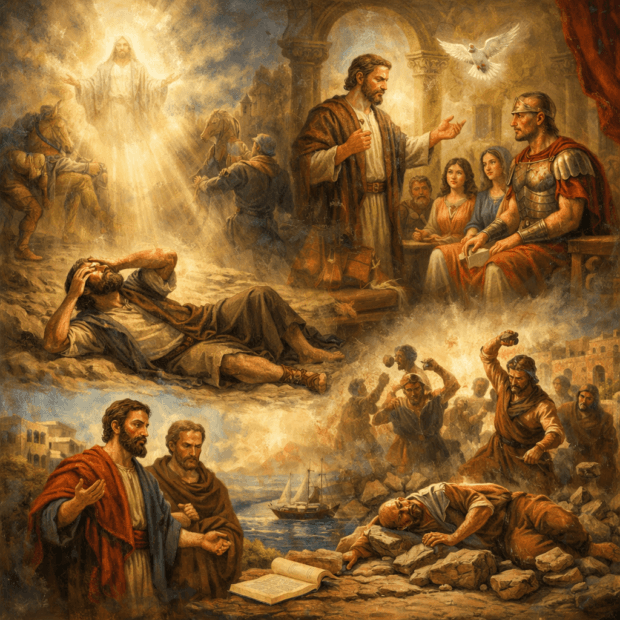
After Stephen’s death, intense persecution breaks out. Believers scatter throughout Judea and Samaria. Yet wherever they go, they preach Christ. Philip brings the Gospel to Samaria, performs miracles, and many believe. Later, he is led by the Spirit to an Ethiopian official, explaining Isaiah’s prophecy and baptizing him on a desert road.
What looked like defeat was divine strategy.
Research in religious history consistently shows that movements often expand fastest during opposition. A study from Baylor University found that communities under pressure often demonstrate stronger evangelistic activity.
As missionary Jim Elliot once said, “Wherever you are, be all there.”
Practical Tip: When life disrupts your plans, ask God how He might use the disruption for greater impact.
Acts 9: The Conversion That Changed Christianity
What if your greatest enemy became your strongest ally?
Acts 9 records one of the most dramatic transformations in Scripture. Saul, a fierce persecutor of Christians, encounters Jesus on the road to Damascus. Blinded and humbled, he surrenders his life to Christ.
Ananias, though afraid, obeys God and ministers to Saul. The former persecutor begins preaching that Jesus is the Son of God.
Saul’s conversion reminds us that no one is beyond God’s reach. According to the Pew Research Center, conversion remains one of the most powerful drivers of religious growth globally.
C.S. Lewis, himself a convert, wrote, “I gave in, and admitted that God was God.”
Practical Tip: Never write someone off. Pray boldly for those who seem far from faith.
Acts 10–11: The Gospel Breaks Cultural Walls
What if the biggest barrier isn’t geography—but prejudice?
In Acts 10, Peter receives a vision that challenges his understanding of clean and unclean. At the same time, Cornelius, a Roman centurion, is instructed by an angel to send for Peter.
When Peter preaches in Cornelius’s home, the Holy Spirit falls upon Gentiles. It is a turning point. The Gospel is not just for the Jews—it is for all.
Peter later explains to the Jerusalem believers, and they glorify God, saying, “Then hath God also to the Gentiles granted repentance unto life.” (Acts 11:18, KJV)
Sociological research shows that religious movements grow significantly when they cross ethnic and cultural boundaries.
Billy Graham once said, “The ground is level at the foot of the cross.”
Practical Tip: Examine your heart for subtle biases. The Gospel is for everyone.
Acts 12: When God Moves Behind Prison Walls
Sometimes the greatest miracles happen in the darkest places.
King Herod intensifies persecution. James is executed. Peter is imprisoned and heavily guarded. The church responds the only way they know how—they pray.
During the night, an angel miraculously frees Peter. Meanwhile, Herod later dies suddenly, and Scripture declares, “But the word of God grew and multiplied.” (Acts 12:24, KJV)
A Harvard study on spiritual resilience found that prayer significantly strengthens hope during crisis.
Corrie ten Boom once said, “There is no panic in heaven. God has no problems, only plans.”
Practical Tip: When circumstances feel impossible, commit to consistent prayer rather than despair.
Acts 13: The First Missionary Journey Begins
The Church in Antioch fasts and prays. The Holy Spirit says, “Separate me Barnabas and Saul for the work whereunto I have called them.” (Acts 13:2, KJV)
This marks the first intentional missionary journey. Paul and Barnabas travel to Cyprus and Asia Minor, preaching in synagogues and to Gentiles. Some believe. Others resist fiercely.
Paul boldly declares that since many Jews reject the message, they will turn to the Gentiles.
Missiological studies confirm that intentional missionary sending has historically accelerated Christian expansion worldwide.
Hudson Taylor, pioneer missionary to China, said, “God’s work done in God’s way will never lack God’s supplies.”
Practical Tip: Be willing to step outside your comfort zone if God calls you somewhere new.
Acts 14: Strength Through Opposition
Growth is rarely comfortable.
In Iconium, Lystra, and Derbe, Paul and Barnabas face both revival and violence. Paul is stoned and left for dead—yet he rises and continues preaching.
They return to strengthen new believers, appoint elders, and encourage them with these words:
“We must through much tribulation enter into the kingdom of God.” (Acts 14:22, KJV)
Research on leadership development shows that resilience is often forged through adversity, not ease.
Helen Keller once said, “Character cannot be developed in ease and quiet.”
Practical Tip: Expect challenges in your faith journey. Hardship often produces maturity.
Conclusion: A Church on the Move
Acts 8–14 shows us a Church that refuses to stand still. Persecution spreads it. Conversion strengthens it. Cultural barriers fall before it. Prayer sustains it. Mission drives it. Opposition refines it.
The Gospel moves from a local movement to an international mission. New leaders emerge. New churches are planted. The name of Jesus travels across borders.
These chapters remind us that faith was never meant to remain private or comfortable. It was meant to move.
The same God who guided Philip to a desert road, met Saul on a highway, and opened Cornelius’s home is still at work today. The question is simple: are we willing to go where He sends and speak what He commands?
The story of Acts is not just history. It is an invitation to participate in a mission that continues to change the world.