What do you do when obedience lands you in chains?
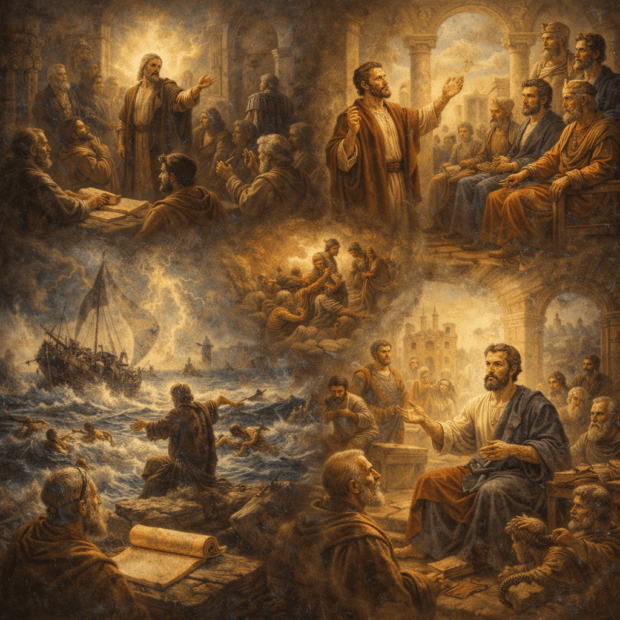
Acts 23–28 brings the Book of Acts to its dramatic close. Paul is no longer traveling freely from city to city. Now he stands before councils, governors, kings, storms, and soldiers. Yet even in confinement, the Gospel keeps moving forward.
These chapters remind us that God’s mission is not limited by circumstances. Courts cannot silence it. Storms cannot sink it. Chains cannot contain it.
Let’s walk through the final stretch of Paul’s journey.
Acts 23: Protected by Providence
When you stand for truth, opposition often intensifies.
In Jerusalem, Paul faces the Sanhedrin. A heated dispute erupts between Pharisees and Sadducees over the resurrection. The conflict becomes so violent that Roman soldiers must intervene to protect him.
That night, the Lord stands by Paul and says:
“Be of good cheer, Paul: for as thou hast testified of me in Jerusalem, so must thou bear witness also at Rome.” (Acts 23:11, KJV)
Meanwhile, more than forty men plot to kill him. The conspiracy is uncovered, and Paul is escorted under heavy guard to Caesarea.
History consistently shows that leadership often invites opposition. Yet divine purpose cannot be overturned by human schemes.
As Charles Stanley once said, “Obey God and leave all the consequences to Him.”
Practical Tip: When facing hostility for your faith, trust that God’s protection and purpose are greater than any plot against you.

Acts 24: Integrity Under Interrogation
How do you respond when falsely accused?
Paul stands trial before Governor Felix. Tertullus presents exaggerated accusations, claiming Paul stirs up rebellion. Paul calmly defends himself, affirming his belief in the resurrection and his clear conscience before God and men.
Felix, though intrigued, delays judgment and keeps Paul imprisoned for two years, hoping for a bribe.
Research in psychology shows that maintaining integrity under pressure strengthens long-term credibility and influence.
Abraham Lincoln once said, “I am not bound to win, but I am bound to be true.”
Practical Tip: Maintain a clear conscience. Integrity matters more than immediate vindication.
Acts 25: Appealing to a Higher Authority
When earthly systems fail, what then?
A new governor, Festus, takes office. Jewish leaders again press charges against Paul. To avoid being returned to Jerusalem—where another ambush awaits—Paul exercises his right as a Roman citizen and appeals to Caesar.
This appeal sets the stage for his journey to Rome.
Legal scholars note that Roman citizenship was a rare privilege in the first century, granting significant protections.
As theologian John Stott observed, “God’s purposes are sometimes accomplished through human legal systems.”
Practical Tip: Use the rights and resources available to you wisely. God can work through ordinary structures to fulfill extraordinary plans.
Acts 26: A Testimony Before a King
Sometimes your greatest platform is unexpected.
Paul stands before King Agrippa and recounts his conversion story in detail. He speaks of his former persecution of Christians and his encounter with Jesus on the road to Damascus.
He boldly declares that Christ’s suffering and resurrection were foretold by the prophets.
Agrippa famously responds, “Almost thou persuadest me to be a Christian.” (Acts 26:28, KJV)
Communication research confirms that personal testimony remains one of the most persuasive forms of influence.
As D.L. Moody said, “There are many of us that are willing to do great things for the Lord, but few of us are willing to do little things.”
Practical Tip: Be ready to share your story clearly and confidently. Your testimony can reach hearts no argument can.
Acts 27: Faith in the Middle of the Storm
What anchors you when everything around you is breaking apart?
On the voyage to Rome, Paul warns the crew of danger, but his advice is ignored. A violent storm—Euroclydon—batters the ship for days. Hope seems lost.
In the midst of chaos, Paul stands and assures them:
“For there stood by me this night the angel of God… saying, Fear not, Paul.” (Acts 27:23–24, KJV)
The ship is eventually wrecked, but every person survives—just as Paul had promised.
Modern resilience studies show that calm leadership during crisis dramatically increases survival and morale.
Corrie ten Boom wrote, “Never be afraid to trust an unknown future to a known God.”
Practical Tip: In life’s storms, anchor your confidence in God’s promises rather than in changing circumstances.
Acts 28: Unhindered to the End
Even shipwreck cannot stop the mission.
Paul and the survivors land on the island of Malta. There, Paul survives a venomous snakebite and heals many of the sick. The Gospel continues spreading even during unexpected detours.
Finally, Paul arrives in Rome. Though under house arrest, he boldly proclaims the kingdom of God for two full years.
The book of Acts ends not with defeat, but with this powerful word:
“Preaching the kingdom of God… with all confidence, no man forbidding him.” (Acts 28:31, KJV)
The story concludes without a formal ending, almost as if to say the mission continues.
Missiologists often describe Christianity as one of history’s most resilient movements, expanding across cultures and centuries despite repeated persecution.
Billy Graham once said, “The Gospel is only good news if it gets there in time.”
Practical Tip: Even when your circumstances feel limiting, look for opportunities to speak hope and truth where you are.
Conclusion: A Gospel That Cannot Be Chained
Acts 23–28 closes the historical narrative, but it opens a greater reality.
Paul faced plots, prisons, political trials, storms, shipwreck, and house arrest. Yet at every stage, God was advancing His purpose. The Gospel moved from Jerusalem to Rome—the heart of the empire.
Chains did not silence Paul. Storms did not drown his mission. Courts did not condemn the truth.
The Book of Acts ends without a tidy conclusion because the story of the Church is still being written.
The question now is not what Paul did—but what we will do.
May we stand firm in trials, speak boldly in opportunities, and trust God’s sovereignty through every storm. The mission continues, and we are invited to carry it forward.