What if everything looked religious on the outside—but God rejected it completely?
Amos 5–9 brings the message to its climax. The warnings intensify. The language sharpens. The illusion of safety disappears. Yet tucked within the judgment is something unexpected—hope.
These final chapters are like a storm that clears the air. They expose empty worship, false security, and coming judgment—but they also point to restoration beyond the ruins.
Let’s walk through the powerful conclusion of Amos.
Amos 5: When Worship Isn’t Accepted
Can worship actually be rejected by God? According to Amos—yes.
God calls Israel to seek Him and live:
“Seek ye me, and ye shall live.” (Amos 5:4, KJV)
But instead of genuine repentance, the people continue their rituals while ignoring justice.
Then comes one of the most striking passages:
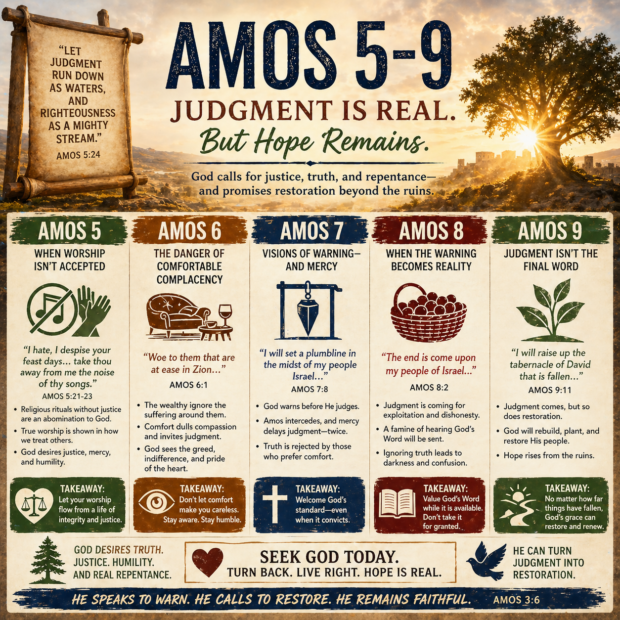
“I hate, I despise your feast days… take thou away from me the noise of thy songs.” (Amos 5:21–23, KJV)
Why such strong words? Because their worship was disconnected from their lives.
“But let judgment run down as waters, and righteousness as a mighty stream.” (Amos 5:24, KJV)
Studies in moral psychology show that people often compartmentalize behavior—acting morally in one area while neglecting another. Amos dismantles that mindset.
As A.W. Tozer said, “God is looking for people through whom He can do the impossible.”
Practical Tip: Align your worship with your daily actions. God desires integrity, not performance.
Amos 6: The Danger of Comfortable Complacency
What’s wrong with being comfortable?
In Amos 6, the issue isn’t just sin—it’s indifference. The wealthy and powerful are at ease while ignoring the suffering around them.
“Woe to them that are at ease in Zion…” (Amos 6:1, KJV)
They enjoy luxury, music, and feasting—but are not grieved by the brokenness of their nation.
Research in behavioral science shows that comfort can dull awareness and reduce motivation for change. When life feels easy, urgency fades.
Martin Luther King Jr. warned, “We will have to repent… not merely for the hateful words of bad people, but for the appalling silence of the good people.”
Practical Tip: Don’t let comfort make you careless. Stay aware of what matters to God.
Amos 7: Visions of Warning—and Mercy
What does God do before judgment? He warns.
Amos receives a series of visions—locusts, fire, and a plumb line. The first two judgments are delayed after Amos intercedes.
But the plumb line reveals a different reality: Israel is measured and found out of alignment.
“I will set a plumbline in the midst of my people Israel…” (Amos 7:8, KJV)
God’s standard doesn’t change—people must align with it.
Amos is then confronted by Amaziah, a priest who tells him to stop prophesying. Truth is rejected by those who prefer comfort.
Leadership studies show that people often resist correction when it threatens their position or identity.
As John Stott said, “Truth becomes hard if we soften it.”
Practical Tip: Welcome God’s standard in your life, even when it exposes uncomfortable truth.
Amos 8: When the Warning Becomes Reality
What happens when people ignore every warning?
Judgment comes.
Amos sees a basket of summer fruit—symbolizing that Israel is ripe for judgment. Their exploitation of the poor and dishonest business practices are highlighted.
“The end is come upon my people of Israel…” (Amos 8:2, KJV)
But one of the most sobering warnings is this:
“I will send a famine… of hearing the words of the Lord.” (Amos 8:11, KJV)
Not a lack of food—but a lack of truth.
Communication studies show that when truth is suppressed or ignored, confusion and instability increase.
Billy Graham once said, “When a nation forgets God, it is not long before it forgets how to live.”
Practical Tip: Value God’s Word while it is available. Don’t take spiritual truth for granted.
Amos 9: Judgment Isn’t the Final Word
Is there hope after judgment?
Yes—and this is where Amos takes an unexpected turn.
The chapter begins with unavoidable judgment—no one can escape God’s reach. But it doesn’t end there.
God promises restoration:
“I will not utterly destroy the house of Jacob…” (Amos 9:8, KJV)
And finally:
“I will raise up the tabernacle of David that is fallen… and I will plant them upon their land.” (Amos 9:11, 15, KJV)
This points forward to renewal, rebuilding, and ultimately to God’s redemptive plan.
Historical patterns—and even modern resilience research—show that restoration is possible after collapse when there is rebuilding on the right foundation.
As Charles Spurgeon said, “God never allows His children to sin successfully.”
Practical Tip: No matter how far things seem to fall, God’s grace can restore what is broken.
Conclusion: Justice, Warning, and Hope
Amos 5–9 brings the message full circle.
We saw worship rejected because it lacked integrity.
We saw comfort turn into complacency.
We saw warnings offered again and again.
We saw judgment become unavoidable.
And finally—we saw hope rise from the ashes.
The message is clear: God desires truth, justice, and genuine relationship—not empty religion.
But even in judgment, He remembers mercy.
Amos ends not in destruction—but in restoration.
May we respond while there is still time. May we live with integrity, seek God sincerely, and walk in alignment with His truth.
Because when God speaks, it’s not just to warn—it’s to call us back.