What if outward religion looked right—but everything underneath was wrong?
The opening chapters of Amos hit like a thunderclap. There’s no gentle introduction, no soft easing in. Instead, the prophet Amos delivers a series of bold warnings—first to surrounding nations, then directly to Israel itself. What begins as judgment on others quickly turns into a mirror.
Think of Amos 1–4 like a courtroom where the audience starts by nodding at others’ guilt… only to realize they’re the ones on trial. These chapters reveal a powerful truth: God cares deeply about justice, integrity, and genuine repentance—not just religious appearance.
Let’s walk through this sobering and eye-opening message.
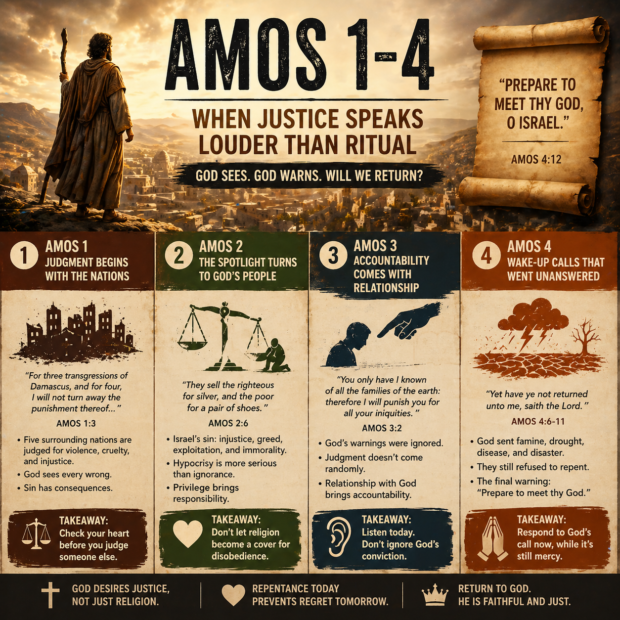
Amos 1: Judgment Begins with the Nations
It’s easy to agree when judgment is aimed at someone else.
Amos begins by pronouncing judgment on surrounding nations—Damascus, Gaza, Tyre, Edom, and Ammon. Each is condemned for cruelty, violence, and injustice.
A repeated phrase echoes:
“For three transgressions… and for four, I will not turn away the punishment thereof…” (Amos 1:3, KJV)
This poetic pattern emphasizes that their sins have reached a tipping point.
Historically, these nations were known for brutality—war crimes, human trafficking, and betrayal. Amos makes it clear: God sees it all.
Modern research in moral psychology shows that people are quick to recognize injustice in others but slow to see it in themselves. Amos is setting up a powerful shift.
As Martin Luther King Jr. said, “Injustice anywhere is a threat to justice everywhere.”
Practical Tip: Before pointing out wrong in others, ask God to reveal what needs correction in your own life.
Amos 2: The Spotlight Turns to God’s People
Here’s where things get uncomfortable.
After addressing surrounding nations, Amos turns to Judah—and then Israel. The tone sharpens. The standard is higher.
Israel is condemned not just for wrongdoing—but for hypocrisy:
“They sell the righteous for silver, and the poor for a pair of shoes.” (Amos 2:6, KJV)
They exploit the vulnerable, twist justice, and indulge in immoral behavior—all while claiming to be God’s people.
Studies in sociology show that moral failure within trusted communities causes deeper harm than wrongdoing outside them. Israel’s sin was not ignorance—it was contradiction.
Dietrich Bonhoeffer wrote, “The greatest danger to the church is not those outside, but compromise within.”
Practical Tip: Don’t let spiritual identity become a substitute for spiritual integrity.
Amos 3: Accountability Comes with Relationship
Does being chosen by God mean protection from judgment? Not quite.
Amos delivers a striking statement:
“You only have I known… therefore I will punish you for all your iniquities.” (Amos 3:2, KJV)
Relationship brings responsibility.
Amos uses a series of rhetorical questions—does a lion roar without prey? Does a trap spring without cause?—to show that judgment doesn’t come randomly. It comes in response to sin.
God had warned His people through prophets, but they ignored Him.
Research in behavioral science shows that repeated warnings without response often lead to stronger consequences. Patterns matter.
A.W. Tozer said, “God is not tolerant of sin just because He is patient.”
Practical Tip: Pay attention to conviction early. Ignoring small warnings can lead to bigger consequences.
Amos 4: Wake-Up Calls That Went Unanswered
What does God do when people refuse to listen?
He sends wake-up calls.
In Amos 4, God lists a series of hardships—famine, drought, crop failure, disease, and disaster—all meant to turn Israel back to Him.
But after each one comes a haunting refrain:
“Yet have ye not returned unto me, saith the Lord.” (Amos 4:6–11, KJV repeated)
This is not just judgment—it’s mercy being ignored.
Psychological studies show that people often resist change even when faced with clear consequences. Without humility, hardship alone doesn’t produce transformation.
The chapter ends with a powerful warning:
“Prepare to meet thy God, O Israel.” (Amos 4:12, KJV)
As C.S. Lewis wrote, “God whispers to us in our pleasures… but shouts in our pains.”
Practical Tip: Don’t wait for bigger problems to turn back to God. Respond quickly when He gets your attention.
Conclusion: When Justice Calls for Response
Amos 1–4 delivers a message that is as relevant today as it was then.
God sees injustice—even when it seems hidden.
He holds His people to a higher standard.
He warns before He judges.
And He calls for real repentance—not empty religion.
These chapters challenge us to move beyond appearances and examine the condition of our hearts. Are we living with integrity? Are we responding to correction? Are we aligning our lives with God’s standard of justice and righteousness?
The message of Amos is clear: God doesn’t just want our words—He wants our lives.
May we listen when He speaks, respond when He calls, and live in a way that reflects both His truth and His justice.