What if the biggest struggle in your life isn’t what you’re facing… but forgetting who you are?
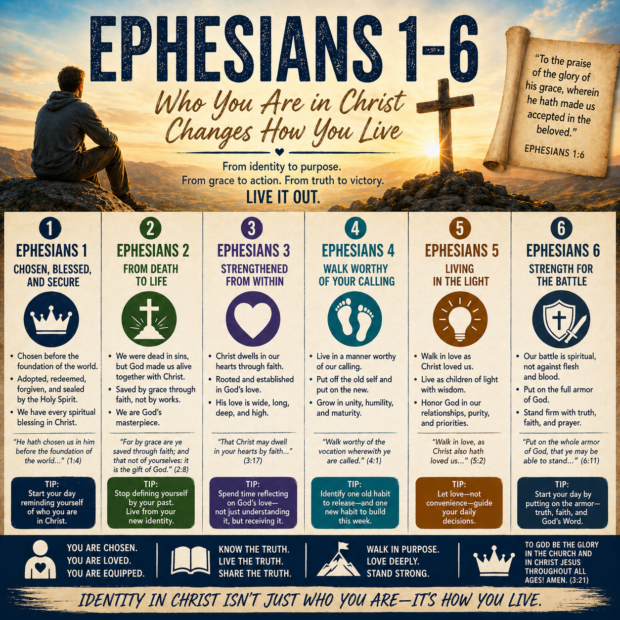
The Book of Ephesians is like a blueprint for identity and purpose. Paul doesn’t start with behavior—he starts with belonging. Before he tells believers how to live, he reminds them who they are in Christ.
Think of Ephesians like a two-part journey. Chapters 1–3 lift your eyes to see your position in Christ. Chapters 4–6 bring your feet back to the ground and show you how to walk it out.
Let’s walk through this powerful letter together.
Ephesians 1: Chosen, Blessed, and Secure
Before you do anything—God has already done everything.
Paul opens with one of the most beautiful declarations in Scripture: believers are blessed with every spiritual blessing in Christ.
“He hath chosen us in him before the foundation of the world…” (Ephesians 1:4, KJV)
You are chosen, adopted, redeemed, forgiven, and sealed by the Holy Spirit.
Identity research shows that people who have a strong sense of belonging experience greater confidence and resilience. Ephesians 1 anchors that belonging in God—not circumstance.
As John Stott said, “The essence of sin is we human beings substituting ourselves for God… the essence of salvation is God substituting Himself for us.”
Practical Tip: Start your day reminding yourself of who you are in Christ—not what you feel.
Ephesians 2: From Death to Life
What if your story didn’t start where you think it did?
Paul paints a stark contrast:
“You hath he quickened, who were dead in trespasses and sins.” (Ephesians 2:1, KJV)
But then comes the turning point:
“But God, who is rich in mercy…” (Ephesians 2:4, KJV)
Salvation is not earned:
“For by grace are ye saved through faith… not of works.” (Ephesians 2:8–9, KJV)
We are God’s workmanship—His masterpiece.
Psychological transformation studies show that identity shifts lead to lasting behavioral change. Paul says—you’re not who you were.
Billy Graham said, “Salvation is free, but it is not cheap. It cost God His Son.”
Practical Tip: Stop defining yourself by your past. Live from your new identity.
Ephesians 3: Strengthened from Within
How do you stay strong when life feels overwhelming?
Paul prays that believers would be strengthened by the Spirit in their inner being—and that they would grasp the vastness of Christ’s love.
“That Christ may dwell in your hearts by faith…” (Ephesians 3:17, KJV)
This love surpasses knowledge—it must be experienced.
Studies in emotional health show that a deep sense of being loved increases resilience and reduces anxiety.
Corrie ten Boom said, “There is no pit so deep that God’s love is not deeper still.”
Practical Tip: Spend time reflecting on God’s love—not just understanding it, but receiving it.
Ephesians 4: Walk Worthy of Your Calling
Now the shift begins.
“Walk worthy of the vocation wherewith ye are called.” (Ephesians 4:1, KJV)
Paul calls for unity, humility, and maturity. He urges believers to put off the old self and put on the new.
Growth is intentional.
Organizational psychology shows that transformation requires both unlearning old habits and practicing new ones.
Rick Warren said, “Spiritual maturity is not measured by what you know, but by how you live.”
Practical Tip: Identify one old habit to release—and one new habit to build this week.
Ephesians 5: Living in the Light
What does a life shaped by Christ actually look like?
Paul calls believers to walk in love, light, and wisdom. He addresses relationships, purity, and priorities.
“Walk in love, as Christ also hath loved us…” (Ephesians 5:2, KJV)
He also gives guidance for marriage—reflecting Christ’s love for the Church.
Behavioral research shows that consistent values-based living leads to stronger relationships and personal fulfillment.
C.S. Lewis wrote, “Integrity is doing the right thing, even when no one is watching.”
Practical Tip: Let love—not convenience—guide your daily decisions.
Ephesians 6: Strength for the Battle
What if your struggle isn’t just physical—but spiritual?
Paul ends with a powerful reminder:
“We wrestle not against flesh and blood…” (Ephesians 6:12, KJV)
He describes the armor of God—truth, righteousness, peace, faith, salvation, and the Word of God.
Spiritual strength requires preparation.
Military and psychological research both confirm that preparation increases resilience under pressure.
As Tony Evans said, “Victory is not the absence of problems—it is the presence of God.”
Practical Tip: Start your day by “putting on” the armor—intentionally focusing on truth, faith, and God’s Word.
Conclusion: Identity That Shapes Everything
Ephesians 1–6 takes us on a powerful journey.
We were chosen and blessed.
We were brought from death to life.
We were strengthened by love.
We were called to walk differently.
We were shown how to live in light.
We were equipped for spiritual battle.
The message is clear: who you are in Christ determines how you live.
You are not striving for identity—you are living from it.
May you walk in confidence, love with intention, and stand strong in the truth of who God says you are.
Because when identity is clear—everything else begins to fall into place.