What happens when people start losing sight of who Jesus really is?
That was the problem facing the church in Colossae. False teachings were creeping in—mixing human philosophy, religious rules, and spiritual confusion with the Gospel. Paul responds with one clear message: Christ is supreme over everything.
The Book of Colossians is like a compass pointing believers back to true north. It reminds us that Christianity is not about empty religion or self-made spirituality—it’s about Jesus Christ being central in every part of life.
Across these four chapters, Paul reveals who Christ is, what He has done, and how that truth transforms the way we live.
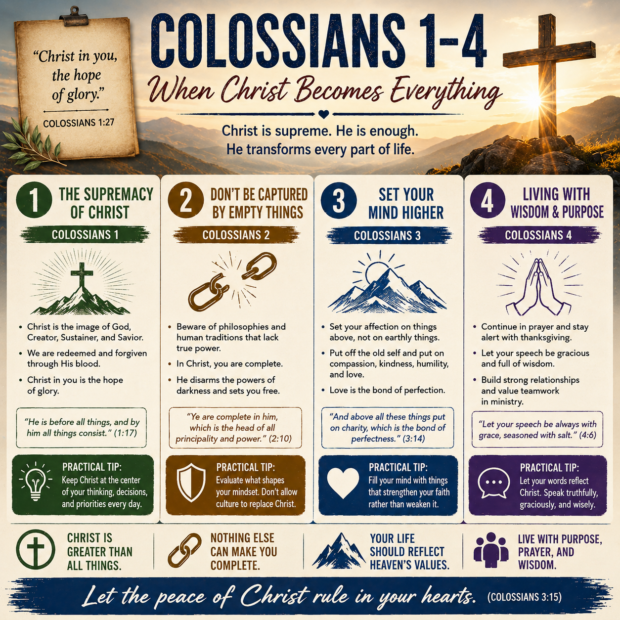
Colossians 1: The Supremacy of Christ
Who is Jesus, really?
Paul answers with breathtaking clarity.
“He is the image of the invisible God…” (Colossians 1:15, KJV)
Christ is not merely a teacher or prophet. He is Creator, Sustainer, and Savior.
“By him were all things created…” (Colossians 1:16, KJV)
Paul also celebrates the believers’ faith, love, and hope, praying that they would grow in spiritual wisdom and walk worthy of the Lord.
Then comes one of the most powerful truths in the letter:
“Christ in you, the hope of glory.” (Colossians 1:27, KJV)
Identity and purpose are found in Him.
Research in psychology shows that people with a strong sense of purpose and identity demonstrate greater emotional resilience and life satisfaction.
As C.S. Lewis wrote, “Christ either deceived mankind by conscious fraud, or He was Himself deluded… or He was Divine.”
Practical Tip: Keep Christ at the center of your thinking, decisions, and priorities every day.
Colossians 2: Don’t Be Captured by Empty Things
What pulls your focus away from Christ?
Paul warns the Colossians about deceptive philosophies and man-made traditions that sound spiritual but lack true power.
“Beware lest any man spoil you through philosophy and vain deceit…” (Colossians 2:8, KJV)
The world offers countless substitutes for spiritual fulfillment—rules, status, self-help, and empty rituals. But Paul reminds believers:
“Ye are complete in him…” (Colossians 2:10, KJV)
In Christ, nothing essential is missing.
Behavioral studies show that people often seek identity through external validation and performance. Paul points believers away from striving and back to completeness in Christ.
A.W. Tozer said, “What comes into our minds when we think about God is the most important thing about us.”
Practical Tip: Evaluate what shapes your mindset. Don’t allow culture to replace Christ as your foundation.
Colossians 3: Set Your Mind Higher
What happens when your identity changes? Your lifestyle changes too.
Paul shifts from theology to transformation:
“Set your affection on things above, not on things on the earth.” (Colossians 3:2, KJV)
Believers are called to put off anger, bitterness, impurity, and dishonesty—and put on compassion, humility, patience, and love.
Then comes a defining verse:
“And above all these things put on charity, which is the bond of perfectness.” (Colossians 3:14, KJV)
Paul also addresses relationships in the home and workplace, showing that Christ affects every part of life.
Modern habit research confirms that lasting change happens when people replace unhealthy behaviors with intentional new patterns.
Dallas Willard wrote, “The most important thing in your life is not what you do; it’s who you become.”
Practical Tip: Fill your mind with things that strengthen your faith rather than weaken it.
Colossians 4: Living with Wisdom and Purpose
How should believers interact with the world around them?
Paul encourages steadfast prayer, spiritual alertness, and wise conduct toward outsiders.
“Continue in prayer, and watch in the same with thanksgiving.” (Colossians 4:2, KJV)
He urges believers to speak with grace and wisdom:
“Let your speech be always with grace…” (Colossians 4:6, KJV)
The chapter closes with personal greetings, reminding us that ministry is built through faithful relationships and teamwork.
Communication studies consistently show that gracious and thoughtful speech builds stronger trust and influence.
Billy Graham once said, “The greatest legacy one can pass on to one’s children and grandchildren is not money… but a legacy of character and faith.”
Practical Tip: Let your words reflect Christ. Speak truthfully, graciously, and wisely.
Conclusion: Christ at the Center of Everything
Colossians 1–4 calls believers back to what matters most.
We saw the supremacy of Christ.
We rejected empty substitutes.
We set our minds on higher things.
We learned to live with wisdom and grace.
Paul’s message is simple but powerful: Jesus is enough.
He is greater than human philosophy.
Greater than religious performance.
Greater than worldly distractions.
Greater than every fear and uncertainty.
When Christ is truly at the center, life begins to align correctly.
May we keep our hearts fixed on Him, our minds grounded in truth, and our lives shaped by His presence.
Because Christianity is not merely about following rules—it is about knowing, trusting, and living for Christ above all else.