What good is sound doctrine if it never changes the way we live?
The Book of Titus is short, but its message is powerful. Paul writes to Titus, a trusted leader serving on the island of Crete, where false teaching and ungodly living were creating problems within the churches.
Rather than focusing only on what believers should know, Paul emphasizes how believers should live. Again and again, he connects sound doctrine with godly behavior.
Think of Titus as a blueprint for authentic Christianity—where truth is not merely believed, but demonstrated through everyday actions.
Across these three chapters, Paul addresses leadership, character, grace, and good works.
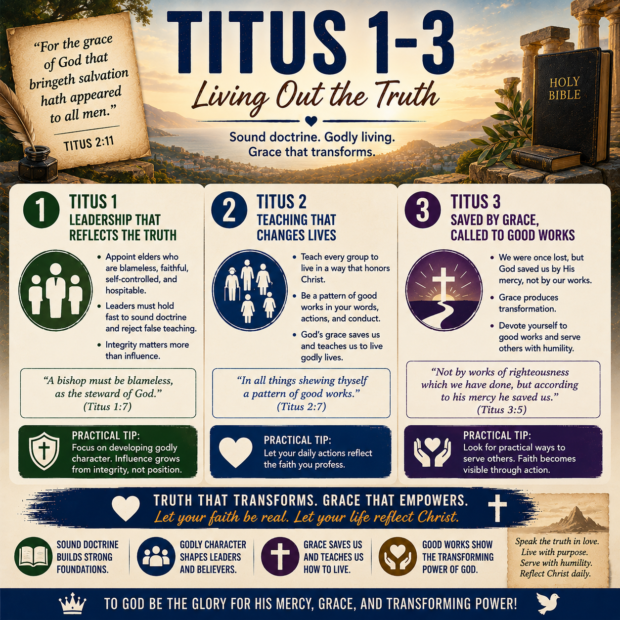
Titus 1: Leadership That Reflects the Truth
What makes someone qualified to lead God’s people?
Paul begins by instructing Titus to appoint elders in every city. The qualifications focus heavily on character rather than talent.
“A bishop must be blameless, as the steward of God.” (Titus 1:7, KJV)
Leaders are called to be self-controlled, faithful, hospitable, and committed to sound doctrine.
Paul also warns about false teachers who were spreading confusion and leading people away from truth.
“Holding fast the faithful word as he hath been taught.” (Titus 1:9, KJV)
Research in leadership studies consistently shows that integrity is one of the most important qualities in effective leadership.
As John Maxwell said, “People may admire your strengths, but they connect with your character.”
Practical Tip: Focus on developing godly character. Influence grows from integrity, not position.
Titus 2: Teaching That Changes Lives
How should faith impact everyday life?
Paul addresses various groups within the church—older men, older women, younger women, young men, and servants. Each is encouraged to live in a way that honors Christ.
The goal is not merely knowledge but transformation.
“In all things shewing thyself a pattern of good works.” (Titus 2:7, KJV)
Then Paul reveals the foundation for Christian living:
“For the grace of God that bringeth salvation hath appeared to all men.” (Titus 2:11, KJV)
Grace not only saves us—it teaches us how to live.
Behavioral science confirms that lasting change occurs when beliefs become part of daily habits and identity.
Dallas Willard wrote, “Grace is not opposed to effort; it is opposed to earning.”
Practical Tip: Let your daily actions reflect the faith you profess.
Titus 3: Saved by Grace, Called to Good Works
How are believers transformed?
Paul reminds Titus that all believers were once lost, disobedient, and spiritually broken.
But everything changed because of God’s mercy.
“Not by works of righteousness which we have done, but according to his mercy he saved us.” (Titus 3:5, KJV)
Salvation is a gift of grace, not a reward for good behavior.
Yet grace produces results.
Paul repeatedly encourages believers to devote themselves to good works—not to earn salvation, but because they have received it.
“Be careful to maintain good works.” (Titus 3:8, KJV)
Studies in positive psychology show that serving others increases purpose, fulfillment, and emotional well-being.
Mother Teresa said, “Faith in action is love—and love in action is service.”
Practical Tip: Look for practical ways to serve others. Faith becomes visible through action.
Conclusion: Truth That Transforms
Titus 1–3 reminds us that Christianity is more than correct beliefs—it is transformed living.
We saw leaders called to integrity.
We learned that grace teaches us how to live.
We discovered that salvation is a gift of mercy.
We were encouraged to devote ourselves to good works.
Paul’s message is clear: sound doctrine should produce godly character.
Faith is not merely something we believe on Sunday—it is something we live every day.
May we embrace God’s grace, pursue spiritual maturity, and reflect Christ through our words, actions, and relationships.
Because when truth takes root in the heart, it becomes visible in the life.
And a life transformed by grace becomes a powerful testimony to the world.