What happens when truth begins to drift?
Paul’s first letter to Timothy is both personal and practical. Timothy was a young leader facing false teaching, church challenges, and the pressure of guiding believers in a difficult culture. Paul writes to strengthen him—not just as a pastor, but as a faithful servant of Christ.
Think of 1 Timothy like a blueprint for spiritual leadership and Christian living. It reminds believers that sound doctrine and godly character must go hand in hand.
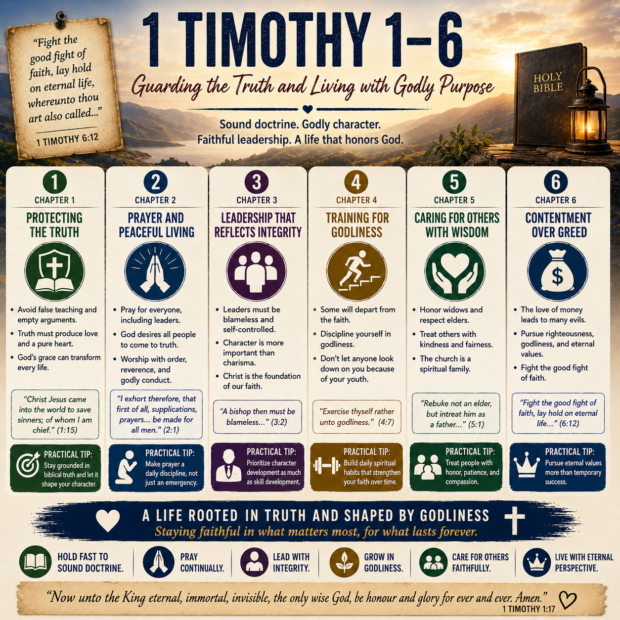
Across these six chapters, Paul addresses truth, prayer, leadership, contentment, discipline, and perseverance.
1 Timothy 1: Protecting the Truth
What happens when people replace truth with speculation?
Paul begins by warning Timothy about false teachers who promote endless arguments and distractions rather than genuine faith.
“The end of the commandment is charity out of a pure heart…” (1 Timothy 1:5, KJV)
Truth should produce love—not pride or confusion.
Paul then reflects on God’s mercy in his own life:
“Christ Jesus came into the world to save sinners; of whom I am chief.” (1 Timothy 1:15, KJV)
His past did not disqualify him. Grace transformed him.
Studies in leadership ethics show that humility and self-awareness are essential for trustworthy leadership.
As John Newton wrote, “I am a great sinner, and Christ is a great Savior.”
Practical Tip: Stay grounded in biblical truth, and let that truth shape your character—not just your knowledge.
1 Timothy 2: Prayer and Peaceful Living
What role does prayer play in a healthy spiritual life?
Paul urges believers to pray for everyone—including leaders and authorities.
“I exhort therefore, that… prayers… be made for all men.” (1 Timothy 2:1, KJV)
Prayer creates spiritual stability and reflects God’s desire for people to come to truth.
Paul also emphasizes orderly worship and godly conduct within the church.
Research in mental wellness consistently shows that prayer and reflection reduce anxiety and increase emotional resilience.
Corrie ten Boom said, “Don’t pray when you feel like it. Have an appointment with the Lord and keep it.”
Practical Tip: Make prayer a daily discipline, not just an emergency response.
1 Timothy 3: Leadership That Reflects Integrity
What qualifies someone to lead spiritually?
Paul outlines qualifications for bishops and deacons, emphasizing character over charisma.
Leaders must be faithful, self-controlled, hospitable, and spiritually mature.
“A bishop then must be blameless…” (1 Timothy 3:2, KJV)
The focus is not perfection—but integrity.
Leadership studies consistently show that long-term influence depends more on trustworthiness than talent.
Billy Graham once said, “Integrity is the glue that holds our way of life together.”
Paul then highlights the greatness of Christ:
“God was manifest in the flesh…” (1 Timothy 3:16, KJV)
Practical Tip: Prioritize character development as much as skill development.
1 Timothy 4: Training for Godliness
What are you training yourself for?
Paul warns that some will depart from the faith, following deceptive teachings. Timothy is instructed to remain grounded in truth and spiritual discipline.
“Exercise thyself rather unto godliness.” (1 Timothy 4:7, KJV)
Just as physical training requires consistency, spiritual growth requires intentional practice.
Modern habit research confirms that repeated daily disciplines shape long-term identity and behavior.
Dallas Willard wrote, “Grace is not opposed to effort; it is opposed to earning.”
Paul also encourages Timothy:
“Let no man despise thy youth…” (1 Timothy 4:12, KJV)
Practical Tip: Build daily spiritual habits that strengthen your faith over time.
1 Timothy 5: Caring for Others with Wisdom
How should believers care for one another?
Paul gives practical instruction about honoring widows, respecting elders, and treating fellow believers like family.
“Rebuke not an elder, but intreat him as a father…” (1 Timothy 5:1, KJV)
The church is not merely an organization—it is a spiritual family.
Studies in community psychology show that strong support systems improve emotional health and resilience.
Mother Teresa said, “If we have no peace, it is because we have forgotten that we belong to each other.”
Practical Tip: Treat people within the church with honor, patience, and compassion.
1 Timothy 6: Contentment Over Greed
How much is enough?
Paul warns against the dangers of loving money:
“The love of money is the root of all evil…” (1 Timothy 6:10, KJV)
Wealth itself is not condemned—but greed is.
Instead, believers are called to pursue righteousness, godliness, faith, love, patience, and meekness.
Then comes Paul’s powerful challenge:
“Fight the good fight of faith…” (1 Timothy 6:12, KJV)
Contentment is not found in possessions—it is found in trusting God.
Research in happiness studies consistently shows that gratitude and meaningful relationships bring greater fulfillment than material wealth.
Jim Elliot wrote, “He is no fool who gives what he cannot keep to gain what he cannot lose.”
Practical Tip: Pursue eternal values more than temporary success.
Conclusion: Faithfulness That Lasts
1 Timothy 1–6 offers timeless wisdom for believers and leaders alike.
We guarded the truth.
We embraced prayer.
We prioritized integrity.
We trained for godliness.
We cared for others wisely.
We pursued contentment over greed.
Paul’s message to Timothy still speaks today: faithfulness matters.
In a world filled with distraction, confusion, and compromise, believers are called to stand firm in truth and live with godly purpose.
May we pursue character over appearance, prayer over panic, and eternal priorities over temporary gain.
Because a life rooted in truth and shaped by godliness leaves an impact that lasts far beyond this world.