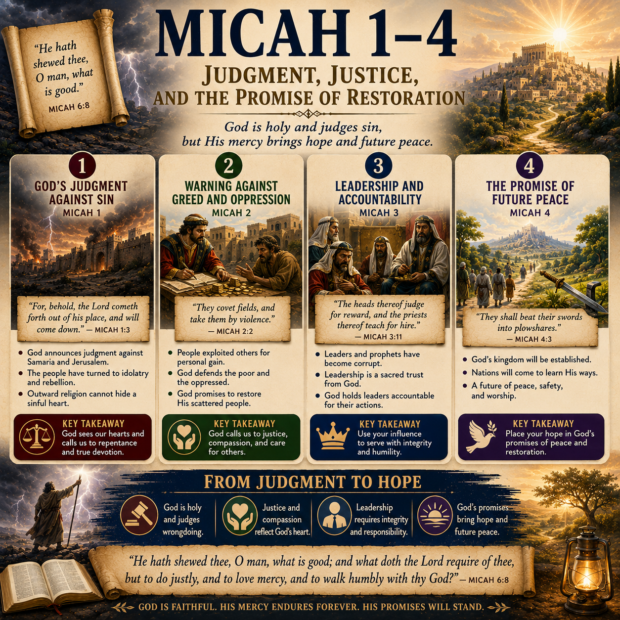
What happens when people turn away from God and ignore justice?
The Book of Micah was written during a time of spiritual decline, corruption, and social injustice. God’s people had become comfortable with idolatry and oppression while neglecting His commands. Through the prophet Micah, God issued serious warnings of judgment, but He also offered hope and promises of future restoration.
Micah’s message is both sobering and encouraging. It reminds us that God cares deeply about how people live, treat others, and respond to Him.
Think of Micah 1–4 as a storm followed by a sunrise. Dark clouds of judgment gather because of sin, but beyond them shines the bright promise of redemption and peace.
These chapters teach us about God’s holiness, His concern for justice, and His unwavering commitment to restore His people.
Micah 1: God’s Judgment Against Sin
Does God overlook wrongdoing?
Micah begins with a dramatic picture of God’s holiness and authority.
“For, behold, the Lord cometh forth out of his place, and will come down.” (Micah 1:3, KJV)
God announces judgment against Samaria and Jerusalem because of idolatry and rebellion.
The people’s outward religious activities could not hide the condition of their hearts.
Sin had become deeply rooted in society, and its consequences would be severe.
This chapter reminds us that God sees beyond appearances and takes sin seriously.
Studies in ethics consistently show that ignoring wrongdoing eventually damages individuals and communities.
Billy Graham said, “Sin will take you farther than you want to go, keep you longer than you want to stay, and cost you more than you want to pay.”
Practical Tip: Regularly examine your heart and invite God to reveal areas that need repentance and change.
Micah 2: Warning Against Greed and Oppression
Why does God care about how people treat one another?
Micah condemns those who used power and wealth to exploit others.
“They covet fields, and take them by violence.” (Micah 2:2, KJV)
People were taking advantage of the vulnerable and using their positions for selfish gain.
God’s concern extends beyond personal morality to how society functions and how people are treated.
Throughout Scripture, God repeatedly defends the poor, the weak, and the oppressed.
Research consistently shows that societies flourish when fairness, compassion, and justice are valued.
Mother Teresa said, “Not all of us can do great things. But we can do small things with great love.”
Even in this chapter of judgment, God promises hope:
“I will surely assemble, O Jacob, all of thee.” (Micah 2:12, KJV)
Practical Tip: Use your resources and influence to help others rather than seeking personal gain at their expense.
Micah 3: Leadership and Accountability
What responsibilities come with leadership?
Micah rebukes corrupt leaders, rulers, and false prophets.
They were entrusted with guiding God’s people but instead pursued personal interests.
“The heads thereof judge for reward, and the priests thereof teach for hire.” (Micah 3:11, KJV)
Leadership carries enormous responsibility because leaders influence the lives of many people.
God holds leaders accountable for how they use their authority.
Research in organizational leadership consistently demonstrates that integrity and servant leadership produce healthier and more effective communities.
John Maxwell said, “A leader is one who knows the way, goes the way, and shows the way.”
Micah’s message challenges every person with influence—whether in family, work, ministry, or community—to lead with honesty and humility.
Practical Tip: Use positions of influence to serve others faithfully and lead with integrity.
Micah 4: The Promise of Future Peace
Does judgment have the final word?
No. Micah’s message suddenly shifts from warning to hope.
He sees a future where God’s kingdom is firmly established.
“The mountain of the house of the Lord shall be established.” (Micah 4:1, KJV)
People from many nations will come to learn God’s ways.
Then comes one of Scripture’s most beautiful pictures of peace:
“They shall beat their swords into plowshares.” (Micah 4:3, KJV)
Weapons of war become instruments of cultivation and life.
Micah describes a future where peace, security, and worship characterize God’s kingdom.
The chapter reminds believers that God’s plans extend beyond present difficulties.
Studies in hope and resilience consistently show that people persevere more effectively when they have confidence in a meaningful future.
Corrie ten Boom said, “Never be afraid to trust an unknown future to a known God.”
Practical Tip: Place your hope in God’s promises and remember that His plans extend beyond today’s circumstances.
Conclusion: From Judgment to Hope
Micah 1–4 reveals both the seriousness of sin and the certainty of God’s promises.
We learned that God sees and judges wrongdoing.
We discovered His concern for justice and compassion.
We saw the importance of integrity in leadership.
We received hope through God’s promise of future peace and restoration.
Micah’s message is clear:
God is holy.
Justice matters.
Leadership carries responsibility.
Hope belongs to those who trust Him.
Even when judgment comes, God’s ultimate desire is restoration.
May we live with humility, practice justice, lead with integrity, and place our hope in God’s eternal kingdom.
Because beyond every storm of discipline and every season of difficulty stands a faithful God whose plans are filled with redemption, peace, and everlasting hope.