What happens when life’s priorities become out of balance?
The Book of Haggai is one of the shortest books in the Bible, yet it delivers a powerful message that remains just as relevant today. After returning from exile, the people of Judah eagerly began rebuilding the Temple. But as challenges arose, they shifted their focus from God’s work to their own comfort and prosperity.
Through the prophet Haggai, God called His people to reexamine their priorities. Their unfinished Temple reflected a deeper spiritual problem—they had placed their own desires ahead of God’s purposes.
Think of Haggai as a compass that points us back to true north. When life’s distractions pull us away from God, His Word redirects our hearts toward what matters most.
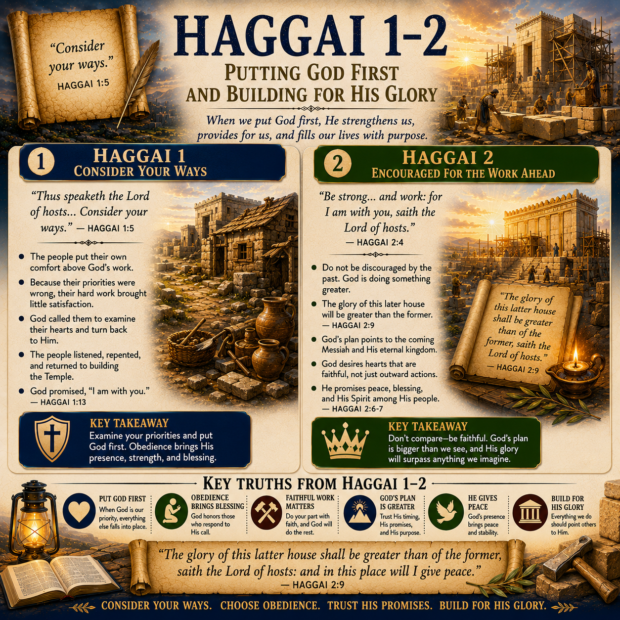
These two chapters teach us that when we put God first, He strengthens us, provides for us, and fills our lives with lasting purpose.
Haggai 1: Consider Your Ways
What happens when we neglect God’s priorities?
Haggai begins with a direct challenge to the people.
“Thus speaketh the Lord of hosts, saying, This people say, The time is not come, the time that the Lord’s house should be built.” (Haggai 1:2, KJV)
While God’s Temple remained unfinished, the people focused on building comfortable homes for themselves.
God responded with a simple but searching command:
“Consider your ways.” (Haggai 1:5, KJV)
Despite their hard work, they experienced little satisfaction because their priorities were misplaced.
“Ye have sown much, and bring in little.” (Haggai 1:6, KJV)
God was not condemning hard work or providing for one’s family. Rather, He was reminding His people that spiritual priorities should come first.
Research in psychology consistently shows that people experience greater fulfillment when their daily activities align with their deepest values and purpose.
Billy Graham said, “When we come to the end of ourselves, we come to the beginning of God.”
Practical Tip: Regularly evaluate your schedule and priorities to ensure that your relationship with God remains at the center of your life.
Obedience Brings Renewal
How did the people respond to God’s message?
Unlike many prophetic books, Haggai records a remarkable response.
The people listened.
“And the people did fear before the Lord.” (Haggai 1:12, KJV)
Instead of making excuses, they obeyed God’s command and resumed rebuilding the Temple.
God immediately encouraged them with a reassuring promise:
“I am with you, saith the Lord.” (Haggai 1:13, KJV)
God’s presence became their greatest source of strength.
Obedience often opens the door for renewed purpose, peace, and spiritual growth.
Studies on habit formation consistently show that meaningful change begins with small, intentional acts of obedience and consistency.
Charles Spurgeon said, “God is most glorified in us when we trust Him completely.”
Practical Tip: Take one practical step of obedience today, trusting that God will guide and strengthen you as you move forward.
Haggai 2: Encouragement for the Work
What if God’s work seems small or insignificant?
Some of the older people remembered Solomon’s magnificent Temple and became discouraged because the new Temple appeared far less impressive.
God encouraged them with these words:
“Be strong… and work: for I am with you, saith the Lord of hosts.” (Haggai 2:4, KJV)
Rather than comparing their work to the past, God invited them to trust His ongoing plan.
Faithfulness matters more than appearances.
The value of our work is measured not by its size but by our obedience to God.
Research in motivation consistently shows that people remain committed when they focus on purpose rather than comparison.
Mother Teresa said, “God has not called me to be successful. He has called me to be faithful.”
Practical Tip: Focus on faithfully serving God where you are instead of comparing your journey with someone else’s.
The Promise of Greater Glory
What future hope did God offer?
Haggai looked beyond the physical Temple to God’s greater plan.
He declared:
“The glory of this latter house shall be greater than of the former.” (Haggai 2:9, KJV)
This promise ultimately points to God’s unfolding plan of redemption through the coming Messiah.
God’s greatest work often unfolds in ways people do not initially recognize.
His plans extend far beyond the present moment.
Research on hope consistently demonstrates that people persevere more effectively when they believe their efforts contribute to a greater purpose.
Corrie ten Boom said, “Faith sees the invisible, believes the unbelievable, and receives the impossible.”
Practical Tip: Trust that God is working behind the scenes, even when you cannot yet see the full results of your faithfulness.
Holiness Begins in the Heart
Can outward actions replace inward devotion?
Haggai reminds the people that true holiness cannot be achieved through outward rituals alone.
God desired hearts that were fully devoted to Him.
As the people returned to faithful obedience, God promised to bless them.
The lesson remains timeless.
God is interested not only in what we do but also in why we do it.
Studies on character development consistently show that lasting transformation begins with inward change rather than external behavior alone.
A.W. Tozer wrote, “What comes into our minds when we think about God is the most important thing about us.”
Practical Tip: Ask God to shape your heart so that your actions flow from genuine love and devotion to Him.
Conclusion: Building What Matters Most
Haggai 1–2 reminds us that our greatest investment is not in temporary achievements but in God’s eternal purposes.
We learned the importance of examining our priorities.
We discovered that obedience brings renewed purpose.
We found encouragement to remain faithful even when progress seems small.
We celebrated God’s promise of greater glory.
We were reminded that true worship begins with a devoted heart.
Haggai’s message is timeless:
Put God first.
Obey His calling.
Trust His promises.
Remain faithful.
Build for His glory.
May we regularly consider our ways, place God’s kingdom above our own ambitions, and trust that every act of faithful obedience contributes to His greater purpose.
Because when God is our highest priority, He transforms ordinary work into eternal significance, strengthens weary hearts, and accomplishes far more than we could ever imagine.