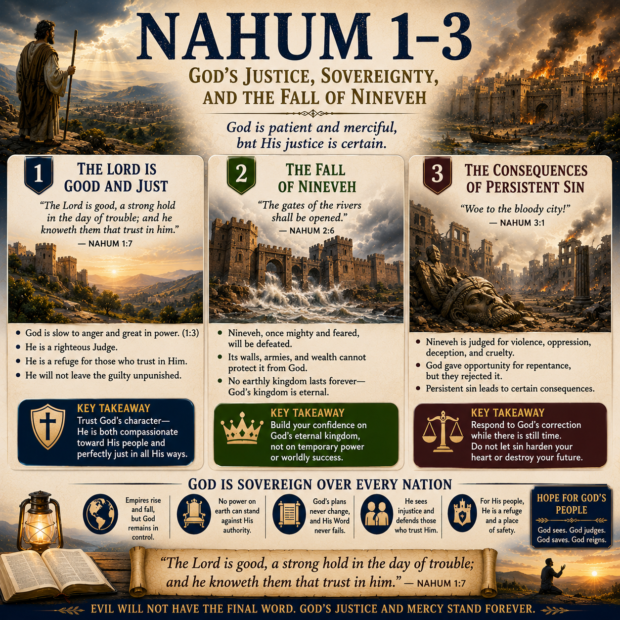
What happens when people repeatedly reject God’s mercy?
The Book of Nahum is a powerful prophecy announcing the fall of Nineveh, the capital of the Assyrian Empire. More than a century earlier, the people of Nineveh had repented after hearing Jonah’s message. But over time, they returned to violence, cruelty, and rebellion against God.
Nahum reminds us that while God is patient and compassionate, His justice is certain. He does not ignore evil forever, and every nation and individual is ultimately accountable to Him.
Think of Nahum as a courtroom where the verdict has finally been announced. God’s patience has been extended, but now justice is carried out. Yet even in the midst of judgment, Nahum offers comfort to those who trust in the Lord.
These three chapters reveal God’s holiness, His power over history, and His unwavering faithfulness to His people.
Nahum 1: The Lord Is Good and Just
Can God be both loving and just?
Nahum begins by describing God’s character.
“The Lord is slow to anger, and great in power.” (Nahum 1:3, KJV)
God is patient, but His patience should never be mistaken for weakness or indifference.
He is both merciful and just.
One of the most comforting verses in the book follows:
“The Lord is good, a strong hold in the day of trouble; and he knoweth them that trust in him.” (Nahum 1:7, KJV)
For those who rebel against Him, God is a righteous Judge.
For those who trust Him, He is a place of refuge and protection.
Research in psychology consistently shows that people experience greater peace and resilience when they have a dependable source of hope during adversity.
Billy Graham said, “God’s mercy and justice are not opposites—they perfectly reflect His holy character.”
Practical Tip: Trust God’s character, knowing that He is both compassionate toward His people and perfectly just in all His ways.
Nahum 2: The Fall of Nineveh
Can even the greatest powers fall?
Nahum vividly describes the coming destruction of Nineveh.
The once-mighty city, feared throughout the ancient world, would be defeated.
“The gates of the rivers shall be opened.” (Nahum 2:6, KJV)
Its military strength, wealth, and reputation could not protect it from God’s judgment.
The prophecy reminds readers that no earthly kingdom lasts forever.
History repeatedly demonstrates that powerful nations eventually rise and fall.
Only God’s kingdom remains eternal.
Research in history consistently shows that pride, injustice, and corruption often contribute to the decline of great civilizations.
C.S. Lewis wrote, “Prosperity knits a man to the world. He feels that he is finding his place in it, while really it is finding its place in him.”
Practical Tip: Build your confidence on God’s eternal kingdom rather than temporary success or worldly power.
Nahum 3: The Consequences of Persistent Sin
Why did Nineveh face such severe judgment?
Nahum explains that Nineveh’s downfall resulted from years of violence, oppression, deception, and cruelty.
“Woe to the bloody city!” (Nahum 3:1, KJV)
God had extended opportunities for repentance, but Nineveh continually rejected His ways.
The chapter reminds us that persistent sin eventually brings consequences.
God’s justice may not always be immediate, but it is always certain.
Studies in behavioral science consistently show that repeated choices shape both personal character and long-term outcomes.
Charles Spurgeon said, “The wheels of God’s justice grind slowly, but they grind exceedingly fine.”
Practical Tip: Respond to God’s correction while there is still time, rather than allowing sinful habits to become firmly established.
God’s Sovereignty Over Every Nation
Who ultimately controls history?
One of Nahum’s greatest themes is God’s sovereignty.
Empires may appear invincible, but they remain subject to God’s authority.
The Assyrian Empire once dominated much of the known world.
Yet God declared its end long before it happened.
This reminds believers that world events never unfold outside God’s knowledge or control.
Throughout Scripture, God consistently demonstrates His authority over kings, kingdoms, and nations.
Studies on resilience consistently show that people find greater stability when they trust in enduring truths rather than changing circumstances.
A.W. Tozer wrote, “God is never surprised, never caught off guard, and never uncertain about the future.”
Practical Tip: When world events create uncertainty, remember that God remains sovereign over history.
Finding Hope in God’s Faithfulness
What comfort does Nahum offer believers?
Although Nahum primarily announces judgment, its message brought hope to God’s people.
The nation of Judah had suffered greatly under Assyrian oppression.
God’s promise to judge Nineveh assured them that evil would not triumph forever.
The Lord remembers His people.
He sees injustice.
He defends those who trust Him.
His justice provides hope because it guarantees that evil will not have the final word.
Research on hope consistently shows that confidence in future justice strengthens perseverance during hardship.
Corrie ten Boom said, “There is no panic in Heaven. God has no problems, only plans.”
Practical Tip: When facing injustice or hardship, trust that God sees every situation and will act according to His perfect timing.
Conclusion: Trusting the God Who Rules History
Nahum 1–3 reminds us that God’s justice and mercy always work together.
We discovered that God is both compassionate and just.
We witnessed the fall of a mighty empire.
We learned that persistent sin has lasting consequences.
We saw God’s authority over every nation.
We found hope in His faithfulness to His people.
Nahum’s message is clear:
God is patient.
God is just.
God is sovereign.
God is our refuge.
No earthly power can stand against Him.
No act of injustice escapes His notice.
No one who trusts in Him is forgotten.
May we place our confidence in God’s unchanging character, walk faithfully in His ways, and find peace in knowing that the Lord who rules over history also watches over those who put their trust in Him.