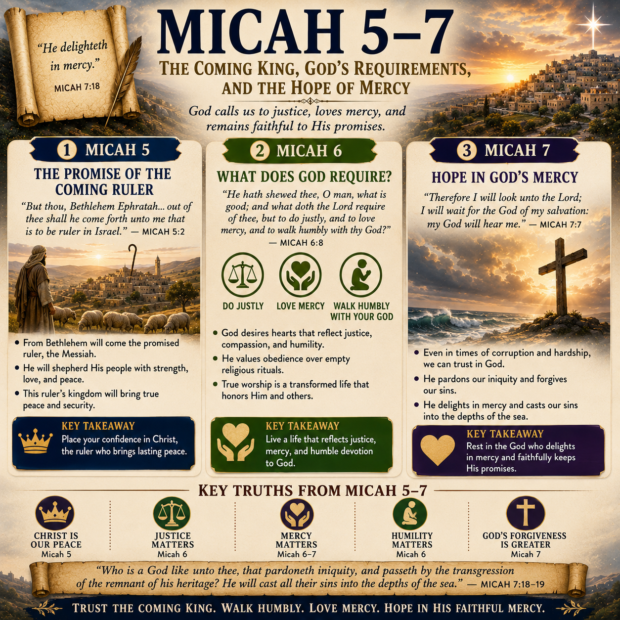
What does God want from His people, and where can we find hope in a broken world?
The final chapters of Micah move from prophecy about a coming ruler to practical instructions about living faithfully before God. They address injustice, corruption, and spiritual decline, but they also reveal one of the Bible’s most beautiful pictures of God’s mercy and forgiveness.
Micah’s message reminds us that God does not ignore sin, yet He never abandons His promises. He calls His people to justice, humility, and trust while pointing them toward a future filled with hope.
Think of Micah 5–7 as a lighthouse during a storm. It exposes dangerous waters but also guides travelers safely toward the shore.
These chapters encourage believers to trust in God’s coming King, walk faithfully with Him, and rest in His amazing mercy.
Micah 5: The Promise of the Coming Ruler
Can hope arise from humble beginnings?
Micah delivers one of the most remarkable Messianic prophecies in Scripture.
“But thou, Bethlehem Ephratah… out of thee shall he come forth unto me that is to be ruler in Israel.” (Micah 5:2, KJV)
From the small town of Bethlehem would come the promised ruler who would shepherd God’s people.
This prophecy points directly to Jesus Christ.
Micah describes Him as a shepherd who provides security and peace.
“And this man shall be the peace.” (Micah 5:5, KJV)
Throughout history, people have searched for security, leadership, and peace. Micah reminds us that true peace is ultimately found in Christ.
Studies in psychology consistently show that people experience greater well-being when they possess hope and trust in meaningful leadership and purpose.
Billy Graham said, “Jesus gives us hope because He keeps us going, peace because He calms our fears, and courage because He shows us the way.”
Practical Tip: Place your confidence in Christ’s leadership rather than temporary sources of security.
Micah 6: What Does God Require?
What kind of life pleases God?
Micah presents a powerful courtroom scene where God reminds His people of His faithfulness and asks why they have turned from Him.
The people wonder what sacrifices they should offer.
Then comes one of the Bible’s most famous verses:
“He hath shewed thee, O man, what is good.” (Micah 6:8, KJV)
And God answers:
“To do justly, and to love mercy, and to walk humbly with thy God.” (Micah 6:8, KJV)
God desires more than religious activity.
He desires transformed hearts that practice justice, show compassion, and live humbly.
Research on human flourishing consistently demonstrates that humility, kindness, and integrity contribute significantly to healthy relationships and communities.
Mother Teresa said, “Humility is the mother of all virtues.”
Practical Tip: Evaluate your daily choices by asking whether they reflect justice, mercy, and humility.
The Importance of Justice and Mercy
Why are justice and mercy inseparable?
Micah repeatedly condemns dishonesty, greed, and exploitation.
God cares deeply about how people treat one another.
Justice protects the vulnerable.
Mercy demonstrates compassion.
Both reflect God’s character.
Studies in ethics consistently show that societies thrive when fairness and compassion work together.
C.S. Lewis wrote, “Mercy, detached from justice, grows unmerciful.”
The Christian life involves both standing for what is right and extending grace toward others.
Practical Tip: Seek opportunities to combine truth and compassion in your relationships and decisions.
Micah 7: Hope in Difficult Times
What happens when society becomes morally confused?
Micah describes widespread corruption and broken relationships.
“The good man is perished out of the earth.” (Micah 7:2, KJV)
The situation appears bleak.
Yet Micah refuses to surrender to despair.
Instead, he declares:
“Therefore I will look unto the Lord; I will wait for the God of my salvation.” (Micah 7:7, KJV)
Faith enables believers to remain hopeful even when circumstances are discouraging.
Research on resilience consistently demonstrates that hope and trust help people persevere through adversity.
Corrie ten Boom said, “Never be afraid to trust an unknown future to a known God.”
Practical Tip: When circumstances become difficult, keep your focus on God rather than allowing fear to dominate your thoughts.
The God Who Delights in Mercy
How does Micah conclude his message?
The book ends with one of the most beautiful descriptions of God’s character in the entire Bible.
“Who is a God like unto thee, that pardoneth iniquity?” (Micah 7:18, KJV)
Then Micah reveals something extraordinary:
“He delighteth in mercy.” (Micah 7:18, KJV)
God does not reluctantly forgive.
He delights in showing mercy.
Micah continues:
“He will cast all their sins into the depths of the sea.” (Micah 7:19, KJV)
The God who judges sin is also the God who forgives, restores, and remains faithful to His promises.
Studies on forgiveness consistently show that extending and receiving forgiveness promotes emotional healing and healthier relationships.
Charles Spurgeon said, “God’s mercy is so great that you may sooner drain the sea of its water than diminish the abundance of His grace.”
Practical Tip: Receive God’s forgiveness with gratitude and extend mercy to others as He has shown mercy to you.
Conclusion: Walking with the God of Mercy
Micah 5–7 beautifully combines prophecy, instruction, and hope.
We met the promised King who brings peace.
We learned what God truly requires of His people.
We discovered the importance of justice and mercy.
We found hope during difficult times.
We celebrated God’s delight in forgiveness and compassion.
Micah’s message is clear:
Christ is our peace.
Justice matters.
Mercy matters.
Humility matters.
God’s forgiveness is greater than our failures.
May we trust the coming King, walk humbly with our God, practice justice and mercy, and place our hope in His unfailing love.
Because the God who calls His people to faithful living is also the God who delights in mercy and faithfully keeps every promise He has made.