What matters most when you know your time is running short?
2 Timothy is Paul’s final recorded letter. Written from prison as he faced execution, these chapters carry the weight of farewell words from a faithful servant who had endured hardship, persecution, betrayal, and suffering—yet never lost sight of Christ.
This letter is deeply personal, but it is also powerfully practical. Paul writes to Timothy like a mentor passing the torch to the next generation.
Think of 2 Timothy as the final charge of a runner nearing the finish line, urging others to keep running with courage and conviction.
Across these four chapters, Paul emphasizes courage, endurance, truth, and faithful perseverance.
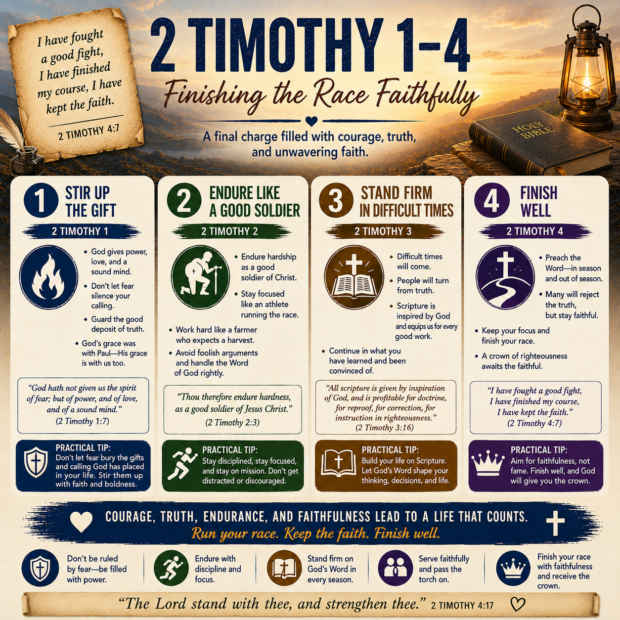
2 Timothy 1: Stir Up the Gift
What happens when fear starts silencing your faith?
Paul begins by encouraging Timothy not to shrink back in fear.
“God hath not given us the spirit of fear; but of power, and of love, and of a sound mind.” (2 Timothy 1:7, KJV)
Timothy was facing pressure, opposition, and responsibility. Paul reminds him to “stir up” the spiritual gift God had given him.
Faithfulness requires courage.
Psychological research shows that fear often causes people to withdraw from purpose and leadership opportunities. Encouragement and conviction help restore confidence.
As Corrie ten Boom said, “Never be afraid to trust an unknown future to a known God.”
Paul also points Timothy back to the Gospel and the importance of guarding sound doctrine.
Practical Tip: Don’t let fear bury the gifts and calling God has placed in your life.
2 Timothy 2: Endure Like a Good Soldier
How do you stay faithful when life gets difficult?
Paul uses powerful illustrations—a soldier, an athlete, and a farmer—to describe Christian endurance.
“Thou therefore endure hardness, as a good soldier of Jesus Christ.” (2 Timothy 2:3, KJV)
Each example highlights discipline, focus, and perseverance.
Paul warns against unnecessary arguments and false teaching while encouraging Timothy to rightly divide the Word of truth.
“Study to shew thyself approved unto God…” (2 Timothy 2:15, KJV)
Studies in resilience and leadership consistently show that long-term perseverance is built through discipline and purpose.
Billy Graham said, “Mountaintops are for views and inspiration, but fruit is grown in the valleys.”
Practical Tip: Stay focused on your mission. Don’t allow distractions or discouragement to pull you off course.
2 Timothy 3: Standing Firm in Difficult Times
What happens when culture drifts further from truth?
Paul gives a sobering description of the “last days,” warning that people will become selfish, proud, unloving, and resistant to truth.
Yet in the middle of that warning, Paul points Timothy back to Scripture:
“All scripture is given by inspiration of God…” (2 Timothy 3:16, KJV)
God’s Word equips believers for every good work.
Modern sociological research confirms that cultures without strong moral foundations often experience growing instability and confusion.
A.W. Tozer wrote, “Nothing less than a whole Bible can make a whole Christian.”
Paul reminds Timothy to continue in what he has learned rather than being swept away by cultural pressure.
Practical Tip: Build your life on Scripture, especially when the world around you becomes unstable.
2 Timothy 4: Finish Well
How do you want your story to end?
Paul gives Timothy one final charge:
“Preach the word; be instant in season, out of season…” (2 Timothy 4:2, KJV)
He warns that many people will prefer messages that suit their desires rather than truth.
Then Paul reflects on his own life with one of the most moving statements in Scripture:
“I have fought a good fight, I have finished my course, I have kept the faith.” (2 Timothy 4:7, KJV)
Paul’s confidence wasn’t rooted in comfort or success—but in faithfulness.
Research in purpose-driven living shows that people who remain committed to meaningful values experience greater fulfillment and resilience over time.
Oswald Chambers said, “Faithfulness to Jesus is the supernatural work of redemption in us.”
Practical Tip: Focus on faithfulness, not popularity. The goal is not just to start well—but to finish well.
Conclusion: A Life Worth Finishing
2 Timothy 1–4 is a powerful reminder that the Christian life is not a sprint—it is a faithful journey.
We stirred up courage instead of fear.
We endured hardship with discipline.
We stood firm on God’s Word.
We committed ourselves to finishing faithfully.
Paul’s final message is clear: guard the truth, endure suffering, and remain faithful to Christ no matter the cost.
The world may change. Culture may shift. Opposition may rise. But God’s calling remains steady.
May we live with courage, stay rooted in Scripture, and run our race with endurance until the very end.
Because in the end, the greatest success is not fame, comfort, or applause—it is being able to say:
“I have kept the faith.”