What happens when pride blinds people to God’s authority?
The Book of Obadiah may be the shortest book in the Old Testament, but its message is powerful and timeless. Written by the prophet Obadiah, this one-chapter book delivers God’s judgment against Edom, a nation that became proud, arrogant, and indifferent to the suffering of others.
Yet Obadiah is more than a prophecy about an ancient nation. It is a reminder that pride always leads to destruction, injustice never escapes God’s notice, and God’s kingdom will ultimately triumph.
Think of Obadiah as a warning sign standing at the edge of a cliff. It reminds us that arrogance and self-reliance may seem secure for a season, but only God’s kingdom endures forever.
Though brief, this book offers profound lessons about humility, compassion, justice, and hope.
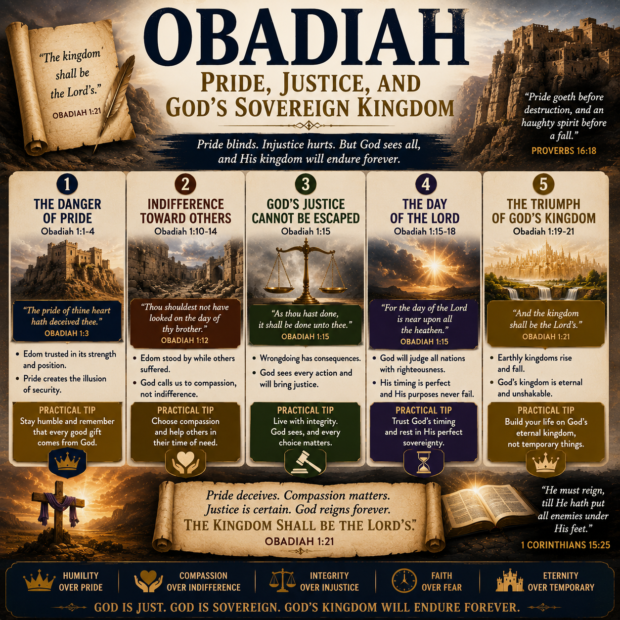
The Danger of Pride
Why is pride so destructive?
Obadiah begins with God’s message against Edom.
The people of Edom believed their mountain strongholds made them untouchable.
“The pride of thine heart hath deceived thee.” (Obadiah 1:3, KJV)
Their confidence was rooted in their position, wealth, and security rather than in God.
Pride often creates the illusion that we are self-sufficient and beyond accountability.
Yet Scripture repeatedly teaches that pride eventually leads to downfall.
Research in leadership and psychology consistently shows that excessive pride often leads to poor decisions, damaged relationships, and failure to recognize weaknesses.
C.S. Lewis wrote, “Pride is the complete anti-God state of mind.”
Practical Tip: Regularly examine your heart and remember that every blessing and achievement ultimately comes from God.
Indifference Toward Others
Why was Edom’s behavior so serious?
Obadiah explains that Edom did not merely become proud—they failed to help others in their time of need.
When Jerusalem suffered, Edom stood by and even took advantage of the situation.
“Thou shouldest not have looked on the day of thy brother.” (Obadiah 1:12, KJV)
Instead of showing compassion, they rejoiced over another nation’s trouble.
God takes seriously how people treat one another.
Studies on empathy consistently demonstrate that compassionate actions strengthen communities and foster healthier relationships.
Mother Teresa said, “If we have no peace, it is because we have forgotten that we belong to each other.”
Practical Tip: Choose compassion over indifference and look for opportunities to help others during difficult times.
God’s Justice Cannot Be Escaped
Does wrongdoing eventually face accountability?
Obadiah delivers a sobering message:
“As thou hast done, it shall be done unto thee.” (Obadiah 1:15, KJV)
The principle is clear: actions have consequences.
God sees injustice, arrogance, and cruelty, and He acts according to His perfect justice.
Though judgment may not come immediately, God never overlooks wrongdoing.
Research in ethics consistently shows that accountability is essential for trust and healthy societies.
Charles Spurgeon said, “God’s justice may move slowly, but it never moves uncertainly.”
Practical Tip: Live with integrity, remembering that our choices matter and that God sees every action.
The Day of the Lord
What does Obadiah teach about God’s future plans?
Obadiah broadens his message beyond Edom and speaks about the Day of the Lord.
“For the day of the Lord is near upon all the heathen.” (Obadiah 1:15, KJV)
The Day of the Lord refers to God’s intervention in history to bring justice and establish His purposes.
This reminder would have encouraged God’s people.
Though evil sometimes appears to prosper, God’s timing and purposes never fail.
Studies in hope and resilience consistently show that people persevere more effectively when they believe justice and meaning ultimately prevail.
Billy Graham said, “God’s justice and mercy are not in conflict. They work together perfectly.”
Practical Tip: Trust God’s timing, even when injustice seems to go unaddressed.
The Triumph of God’s Kingdom
How does this short book end?
Despite its warnings of judgment, Obadiah concludes with hope.
God promises restoration and victory for His people.
The book ends with one of its most powerful declarations:
“And the kingdom shall be the Lord’s.” (Obadiah 1:21, KJV)
This statement changes everything.
Earthly kingdoms rise and fall. Nations gain power and lose influence. Human achievements come and go.
But God’s kingdom is eternal.
Research on purpose and meaning consistently shows that people experience greater peace when they invest their lives in values that endure.
A.W. Tozer wrote, “God’s sovereignty is the one impregnable rock to which the suffering human heart must cling.”
Practical Tip: Build your life around God’s eternal kingdom rather than temporary success and possessions.
Conclusion: Humility Before the Eternal King
The Book of Obadiah may contain only one chapter, but its message is profound.
We learned about the danger of pride.
We saw the importance of compassion.
We were reminded that God’s justice cannot be escaped.
We discovered the hope found in the Day of the Lord.
We celebrated the triumph of God’s eternal kingdom.
Obadiah’s message is clear:
Pride deceives.
Compassion matters.
Justice is certain.
God reigns forever.
May we choose humility over arrogance, compassion over indifference, and faith over fear.
Because no earthly kingdom lasts forever, but the kingdom of the Lord will endure forever.
And when everything else fades away, one truth remains:
“The kingdom shall be the Lord’s.” (Obadiah 1:21, KJV)