Why does God sometimes seem silent when injustice is everywhere?
The Book of Habakkuk is unlike most prophetic books in the Bible. Instead of delivering God’s message to the people, the prophet Habakkuk brings his questions directly to God. He struggles with violence, injustice, and suffering, asking why evil appears to prosper while the righteous suffer.
Rather than rebuking Habakkuk for asking difficult questions, God patiently answers him. Through this conversation, Habakkuk learns that while he may not understand God’s timing or methods, he can always trust God’s character.
Think of Habakkuk as a traveler walking through a dense fog. The path ahead is unclear, but the Guide knows exactly where the journey leads. Faith is learning to trust the Guide even when we cannot see the road.
These three chapters remind believers that faith is not the absence of questions—it is choosing to trust God even when the answers are delayed.
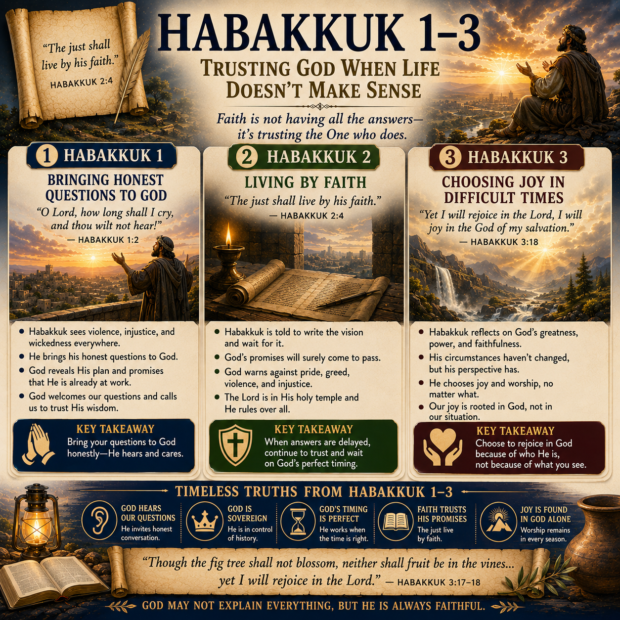
Habakkuk 1: Bringing Honest Questions to God
Is it wrong to ask God difficult questions?
Habakkuk begins by pouring out his heart.
“O Lord, how long shall I cry, and thou wilt not hear!” (Habakkuk 1:2, KJV)
He sees violence, injustice, corruption, and suffering all around him. Wickedness seems to prevail while justice appears absent.
God responds in an unexpected way. He tells Habakkuk that He is already working, even though the prophet cannot yet see it.
“I will work a work in your days, which ye will not believe.” (Habakkuk 1:5, KJV)
God explains that He will use the Babylonian Empire to discipline Judah—a response that raises even more questions for Habakkuk.
This chapter reminds us that God welcomes sincere questions while calling us to trust His wisdom.
Research in psychology consistently shows that expressing honest emotions and seeking understanding promotes resilience during difficult seasons.
C.S. Lewis wrote, “God whispers to us in our pleasures, speaks in our conscience, but shouts in our pains.”
Practical Tip: Bring your questions honestly to God through prayer, trusting that He welcomes sincere hearts seeking His wisdom.
Habakkuk 2: Living by Faith
How should believers respond when they don’t understand God’s plan?
Habakkuk chooses to wait for God’s answer.
“I will stand upon my watch.” (Habakkuk 2:1, KJV)
God tells him to write down the vision because His promises will certainly come to pass.
Then comes one of the most important verses in the entire Bible:
“The just shall live by his faith.” (Habakkuk 2:4, KJV)
Faith means trusting God’s promises even when circumstances appear confusing.
God also pronounces judgment against pride, greed, violence, and injustice, assuring Habakkuk that evil will not triumph forever.
The chapter concludes with a powerful reminder:
“But the Lord is in his holy temple: let all the earth keep silence before him.” (Habakkuk 2:20, KJV)
Studies on resilience consistently show that people who maintain hope and purpose are better equipped to navigate uncertainty.
Billy Graham said, “Faith is taking God at His Word.”
Practical Tip: When answers are delayed, continue walking faithfully, knowing that God’s timing is always perfect.
God’s Sovereignty Over History
Who is really in control of world events?
Habakkuk learns that nations rise and fall according to God’s purposes.
Although evil may appear powerful for a season, God remains sovereign over every kingdom and every generation.
History unfolds according to His perfect plan, not human ambition.
Throughout Scripture, God consistently demonstrates His authority over rulers, nations, and world events.
Research in leadership and decision-making shows that people experience greater peace when they focus on what they can faithfully control while trusting what lies beyond their understanding.
A.W. Tozer wrote, “God is never surprised, never caught off guard, and never uncertain about the future.”
Practical Tip: When world events create uncertainty, remember that God remains firmly in control of history.
Habakkuk 3: Choosing Joy in Difficult Times
Can we rejoice even when life is hard?
Habakkuk’s conversation with God ends in worship.
Instead of focusing on unanswered questions, he reflects on God’s greatness, power, and faithfulness throughout history.
Then he makes one of Scripture’s most remarkable declarations:
“Although the fig tree shall not blossom… yet I will rejoice in the Lord.” (Habakkuk 3:17–18, KJV)
Habakkuk’s circumstances have not changed.
The uncertainty remains.
Yet his perspective has changed completely.
His joy is no longer based on circumstances but on God’s unchanging character.
Research on gratitude consistently shows that choosing thankfulness strengthens emotional well-being and resilience during adversity.
Corrie ten Boom said, “Never be afraid to trust an unknown future to a known God.”
Practical Tip: Build your joy on God’s faithfulness rather than on changing circumstances.
Faith That Endures Every Season
What does genuine faith look like?
The journey of Habakkuk teaches that mature faith does not require having every answer.
Faith trusts God’s wisdom when life feels confusing.
It waits patiently when answers seem delayed.
It worships even during hardship.
It believes God’s promises even before they become visible.
Habakkuk’s transformation encourages every believer facing uncertainty.
God may not always explain everything, but He always remains faithful.
Studies on perseverance consistently demonstrate that hope rooted in lasting purpose enables people to endure life’s greatest challenges.
Charles Spurgeon said, “God is too good to be unkind and too wise to be mistaken.”
Practical Tip: Strengthen your faith daily through prayer, Scripture, and remembering God’s faithfulness in your own life.
Conclusion: Trusting God Beyond Our Understanding
Habakkuk 1–3 reminds us that faith grows strongest during life’s most difficult questions.
We learned that God welcomes honest prayer.
We discovered that the righteous live by faith.
We saw God’s sovereign rule over history.
We found joy that rises above circumstances.
We learned to trust God’s character when His plans remain unseen.
Habakkuk’s message is timeless:
God hears our questions.
God remains in control.
Faith overcomes fear.
Joy is possible even in hardship.
May we follow Habakkuk’s example by bringing our questions honestly to God, waiting patiently for His timing, and choosing to trust Him regardless of our circumstances.
Because the God who guided Habakkuk through uncertainty is the same God who walks with us today—and He is always worthy of our faith.