How can believers know they truly belong to God?
In a world filled with confusion, deception, and uncertainty, the Apostle John wrote a letter to strengthen believers and give them confidence in their faith. Unlike many New Testament letters that focus on church issues, 1 John centers on assurance, truth, love, and fellowship with God.
John repeatedly contrasts light and darkness, truth and error, love and hatred. His message is simple yet profound: those who know God will reflect His character.
Think of 1 John as a spiritual compass. It helps believers stay pointed toward Christ while providing assurance that they are walking in the truth.
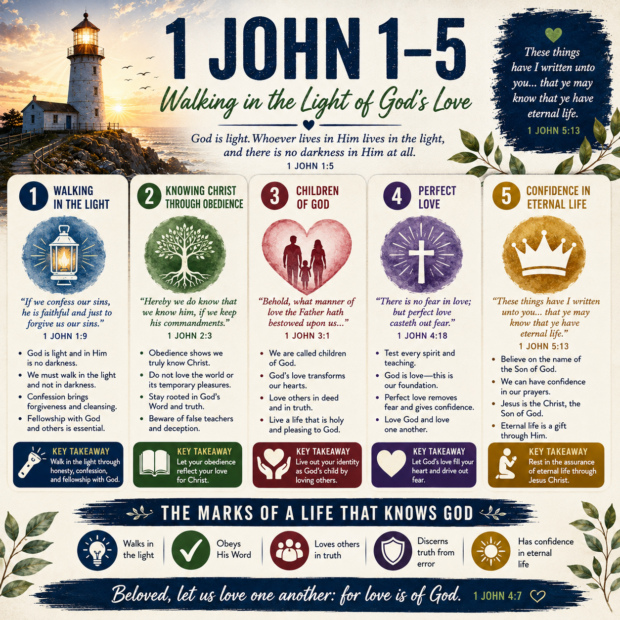
Across these five chapters, John teaches believers how to walk in the light, live in love, and rest in the confidence of eternal life.
1 John 1: Walking in the Light
What does it mean to have fellowship with God?
John begins by proclaiming Jesus Christ as the eternal Word of Life whom he personally witnessed.
“That which we have seen and heard declare we unto you.” (1 John 1:3, KJV)
He then reveals a foundational truth:
“God is light, and in him is no darkness at all.” (1 John 1:5, KJV)
Those who claim to follow God must walk in His light rather than live in darkness.
John also addresses sin honestly:
“If we confess our sins, he is faithful and just to forgive us our sins.” (1 John 1:9, KJV)
The Christian life is not about pretending to be perfect—it is about living transparently before God and receiving His forgiveness.
Studies in emotional well-being consistently show that honesty and accountability contribute to healthier relationships and personal growth.
Billy Graham said, “The Christian life is not a constant high. I have my moments of deep discouragement, but I go to God in prayer with my tears.”
Practical Tip: Practice regular self-examination and confess sins quickly when God brings them to your attention.
1 John 2: Knowing Christ Through Obedience
How can we know that our faith is genuine?
John provides a clear answer:
“Hereby we do know that we know him, if we keep his commandments.” (1 John 2:3, KJV)
Obedience does not earn salvation, but it demonstrates a genuine relationship with Christ.
John also warns believers against loving the world and its temporary pleasures.
“Love not the world, neither the things that are in the world.” (1 John 2:15, KJV)
The chapter emphasizes spiritual maturity and remaining faithful to Christ despite false teachings.
Behavioral research shows that authentic commitment is revealed through consistent actions over time.
A.W. Tozer wrote, “The true follower of Christ will not ask, ‘If I embrace this truth, what will it cost me?’ Rather he will ask, ‘If I reject this truth, what will it cost?’”
Practical Tip: Evaluate whether your daily choices reflect your commitment to Christ.
1 John 3: Children of God
What makes someone a child of God?
John marvels at God’s incredible love:
“Behold, what manner of love the Father hath bestowed upon us, that we should be called the sons of God.” (1 John 3:1, KJV)
Believers are not merely followers of Christ—they are members of God’s family.
Because of this new identity, their lives should reflect God’s character.
John highlights one of the key marks of genuine faith:
“Let us not love in word, neither in tongue; but in deed and in truth.” (1 John 3:18, KJV)
True love is demonstrated through action.
Research in relationship studies consistently finds that meaningful love is expressed through consistent acts of care and service.
Mother Teresa said, “Not all of us can do great things. But we can do small things with great love.”
Practical Tip: Look for practical ways to demonstrate God’s love through your actions.
1 John 4: Perfect Love
How can believers recognize truth and overcome fear?
John encourages believers to test spiritual teachings carefully:
“Beloved, believe not every spirit, but try the spirits whether they are of God.” (1 John 4:1, KJV)
Discernment is essential because not every message claiming spiritual authority comes from God.
The chapter then focuses on God’s love:
“God is love.” (1 John 4:8, KJV)
One of the most comforting promises follows:
“Perfect love casteth out fear.” (1 John 4:18, KJV)
God’s love provides security, confidence, and peace.
Studies in psychology show that love and secure relationships significantly reduce anxiety and fear.
Corrie ten Boom said, “There is no fear in love; but perfect love drives out fear.”
Practical Tip: Focus on God’s love when fear begins to dominate your thoughts.
1 John 5: Confidence in Eternal Life
Can believers know they have eternal life?
John’s answer is a resounding yes.
“These things have I written unto you… that ye may know that ye have eternal life.” (1 John 5:13, KJV)
Faith in Jesus Christ provides assurance of salvation.
John also highlights the power of prayer and confidence in God’s promises.
“This is the confidence that we have in him, that, if we ask any thing according to his will, he heareth us.” (1 John 5:14, KJV)
The chapter concludes by reaffirming the truth about Jesus Christ and the eternal life found in Him.
Research in hope and spirituality consistently shows that certainty about one’s purpose and future contributes to greater emotional stability and resilience.
Charles Spurgeon said, “A little faith will bring your soul to heaven; a great faith will bring heaven to your soul.”
Practical Tip: Rest in God’s promises and approach Him confidently in prayer.
Conclusion: Living in the Light
1 John 1–5 provides believers with assurance, encouragement, and practical guidance for daily living.
We learned to walk in God’s light.
We discovered that obedience reflects genuine faith.
We embraced our identity as God’s children.
We experienced the power of His perfect love.
We gained confidence in eternal life.
John’s message is clear: those who truly know God will reflect His character.
They will walk in truth.
They will love others.
They will obey God’s commands.
They will live with confidence in Christ.
May we remain rooted in God’s love, grounded in His truth, and confident in His promises.
Because when we walk in the light of Christ, we can live with peace, purpose, and the assurance that we belong to Him forever.