What if your greatest challenges could actually strengthen your faith?
The Book of 1 Peter was written to believers facing persecution, hardship, and uncertainty. Many were suffering because of their faith in Christ and wondering how they should respond.
Peter doesn’t promise an easy life. Instead, he points believers to a living hope, reminding them that trials are temporary, God’s promises are eternal, and suffering can produce spiritual growth.
Think of 1 Peter as a guidebook for navigating storms. It doesn’t remove the storm, but it teaches believers how to stand firm while trusting God through it.
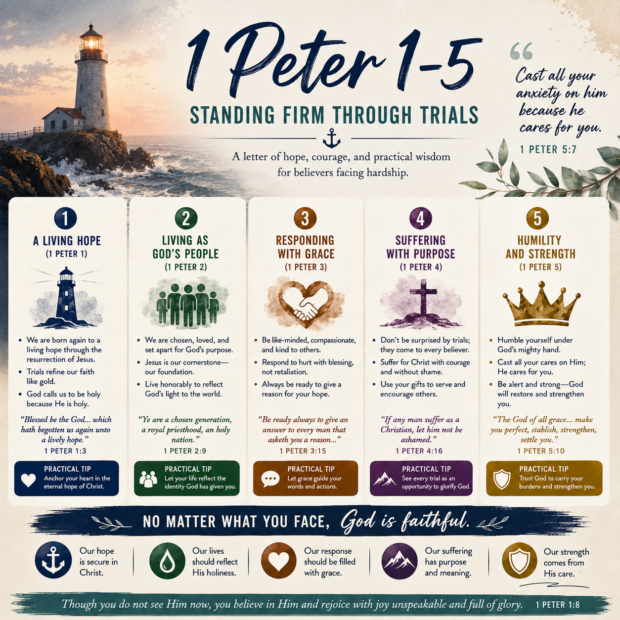
Across these five chapters, Peter focuses on hope, holiness, submission, suffering, humility, and perseverance.
Let’s explore this encouraging letter.
1 Peter 1: A Living Hope
Where can believers find hope when life becomes difficult?
Peter begins by reminding believers of their secure salvation in Christ.
“Blessed be the God and Father of our Lord Jesus Christ, which according to his abundant mercy hath begotten us again unto a lively hope.” (1 Peter 1:3, KJV)
This hope is not based on circumstances but on Christ’s resurrection.
Peter explains that trials can strengthen faith just as fire refines gold.
“The trial of your faith, being much more precious than of gold that perisheth…” (1 Peter 1:7, KJV)
He then calls believers to holiness:
“Be ye holy; for I am holy.” (1 Peter 1:16, KJV)
Research in resilience psychology shows that hope is one of the strongest predictors of perseverance during adversity.
Billy Graham said, “Hope is the anchor of the soul, the stimulus to action, and the incentive to achievement.”
Practical Tip: When difficulties arise, focus on the eternal hope you have in Christ rather than temporary circumstances.
1 Peter 2: Living as God’s People
How should believers live in a world that often opposes their values?
Peter describes Christians as:
“A chosen generation, a royal priesthood, an holy nation.” (1 Peter 2:9, KJV)
Believers are called to reflect God’s character through their conduct.
Peter also describes Christ as the cornerstone upon which faith is built.
“The stone which the builders disallowed, the same is made the head of the corner.” (1 Peter 2:7, KJV)
He encourages believers to live honorably before others, even when facing criticism.
Studies in social influence consistently show that actions often communicate more powerfully than words.
John Stott wrote, “The Christian life is not a matter of what we do but of what God has done and is doing in us.”
Practical Tip: Let your lifestyle reflect the faith you profess.
1 Peter 3: Responding with Grace
How should believers respond when treated unfairly?
Peter encourages humility, compassion, and kindness in relationships.
“Be ye all of one mind, having compassion one of another.” (1 Peter 3:8, KJV)
Instead of returning evil for evil, believers are called to respond with blessing.
Peter points to Christ’s example of suffering and obedience.
He also encourages believers to be ready to explain their faith:
“Be ready always to give an answer to every man that asketh you a reason of the hope that is in you.” (1 Peter 3:15, KJV)
Communication studies show that respectful and gracious responses often create greater opportunities for meaningful conversations.
Corrie ten Boom said, “Love is larger than the walls which shut it in.”
Practical Tip: Respond to difficult people with grace rather than retaliation.
1 Peter 4: Suffering with Purpose
Why does God allow believers to experience suffering?
Peter teaches that suffering for Christ should not surprise believers.
“Think it not strange concerning the fiery trial which is to try you.” (1 Peter 4:12, KJV)
Instead, suffering can become an opportunity to glorify God.
“If any man suffer as a Christian, let him not be ashamed.” (1 Peter 4:16, KJV)
Peter also encourages believers to use their spiritual gifts to serve one another faithfully.
Research into personal growth often reveals that adversity can develop character, empathy, and resilience.
A.W. Tozer wrote, “It is doubtful whether God can bless a man greatly until He has hurt him deeply.”
Practical Tip: View challenges as opportunities to trust God and strengthen your faith.
1 Peter 5: Humility and Strength
How can believers remain strong during spiritual battles?
Peter addresses church leaders and encourages them to serve willingly and faithfully.
Then he turns to all believers:
“Humble yourselves therefore under the mighty hand of God.” (1 Peter 5:6, KJV)
One of the most comforting promises follows:
“Casting all your care upon him; for he careth for you.” (1 Peter 5:7, KJV)
Peter warns believers to remain alert because of spiritual opposition:
“Be sober, be vigilant…” (1 Peter 5:8, KJV)
Yet he concludes with encouragement:
“The God of all grace… make you perfect, stablish, strengthen, settle you.” (1 Peter 5:10, KJV)
Studies in emotional well-being consistently show that surrendering anxiety and maintaining supportive faith practices improve resilience and peace.
Charles Spurgeon said, “Anxiety does not empty tomorrow of its sorrows, but only empties today of its strength.”
Practical Tip: Give your worries to God daily and trust Him to sustain you.
Conclusion: Hope That Endures
1 Peter 1–5 offers powerful encouragement for believers facing challenges.
We discovered a living hope through Christ.
We learned to live as God’s chosen people.
We responded to opposition with grace.
We found purpose in suffering.
We embraced humility and trusted God’s care.
Peter’s message is clear: trials are temporary, but God’s promises are eternal.
No matter what difficulties arise, believers can stand firm because their hope is anchored in Christ.
May we live with courage during hardship, holiness in our conduct, and confidence in God’s faithfulness.
Because the same God who saves us is the God who strengthens us, sustains us, and carries us safely through every trial.