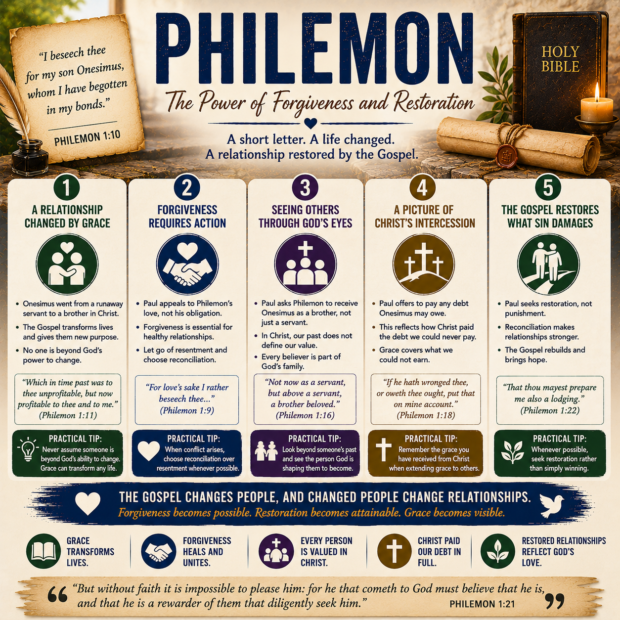
What happens when the Gospel transforms not only a person’s heart, but also their relationships?
The Book of Philemon may be one of the shortest books in the Bible, but its message is profound. In just 25 verses, Paul addresses issues that remain relevant today—grace, forgiveness, reconciliation, and the value of every person in God’s family.
This personal letter centers around a runaway servant named Onesimus, his master Philemon, and Paul, who acts as a bridge between them. What unfolds is a beautiful picture of how the Gospel changes lives and restores broken relationships.
Think of Philemon as a living illustration of God’s grace. Just as Christ reconciles sinners to God, Paul encourages reconciliation between two believers whose relationship has been damaged.
Let’s explore the powerful lessons found in this remarkable letter.
A Relationship Changed by Grace
Can a person truly change?
Onesimus had once been an unprofitable servant who apparently ran away from Philemon. During his journey, he encountered Paul and became a follower of Christ.
Paul writes:
“Which in time past was to thee unprofitable, but now profitable to thee and to me.” (Philemon 1:11, KJV)
The Gospel transformed Onesimus from a fugitive into a faithful brother in Christ.
Studies in behavioral psychology show that genuine transformation often begins when people discover a new identity and purpose. The Gospel offers both.
As John Newton, author of Amazing Grace, famously said, “I am not what I ought to be, I am not what I wish to be, but by the grace of God, I am not what I was.”
Practical Tip: Never assume someone is beyond God’s ability to change. Grace can transform any life.
Forgiveness Requires Action
Why is forgiveness often so difficult?
Paul sends Onesimus back to Philemon, knowing there may be consequences. Yet he appeals to Philemon’s Christian character rather than demanding compliance.
“For love’s sake I rather beseech thee…” (Philemon 1:9, KJV)
Forgiveness is rarely easy, but it is essential for healthy relationships.
Research consistently shows that forgiveness reduces stress, improves emotional health, and strengthens relationships. More importantly, Scripture teaches that forgiven people are called to forgive others.
C.S. Lewis wrote, “Everyone says forgiveness is a lovely idea until they have something to forgive.”
Practical Tip: When conflict arises, choose reconciliation over resentment whenever possible.
Seeing Others Through God’s Eyes
How do we view people who have failed us?
Paul asks Philemon to receive Onesimus:
“Not now as a servant, but above a servant, a brother beloved.” (Philemon 1:16, KJV)
The Gospel changes how believers view one another. Social status, past mistakes, and personal failures no longer define a person’s worth.
In Christ, every believer becomes part of God’s family.
Modern studies on community and belonging show that people thrive when they are accepted and valued rather than defined by their failures.
Mother Teresa said, “If we judge people, we have no time to love them.”
Practical Tip: Look beyond someone’s past and see the person God is shaping them to become.
A Picture of Christ’s Intercession
Did you know Paul reflects the work of Christ in this letter?
Paul offers to personally cover any debt Onesimus owes.
“If he hath wronged thee, or oweth thee ought, put that on mine account.” (Philemon 1:18, KJV)
This is a beautiful picture of what Jesus has done for believers. Our sin created a debt we could never pay, yet Christ took our place and paid it for us.
The message of redemption runs throughout Scripture, and Philemon provides a practical example of it in action.
Charles Spurgeon wrote, “Jesus stands as the great surety for His people.”
Practical Tip: Remember the grace you have received from Christ when extending grace to others.
The Gospel Restores What Sin Damages
Can broken relationships truly be restored?
The heart of Philemon is reconciliation. Paul hopes that what was once broken will become stronger than before because of Christ.
Rather than focusing on punishment, Paul focuses on restoration.
The Gospel does more than forgive—it rebuilds.
Research into conflict resolution consistently finds that restored relationships often become stronger when both parties pursue forgiveness and understanding.
Billy Graham said, “God’s mercy and grace give me hope—for myself and for our world.”
Practical Tip: Whenever possible, seek restoration rather than simply winning an argument.
Conclusion: Grace That Changes Relationships
The Book of Philemon may be brief, but its message carries lasting impact.
We saw a life transformed by grace.
We learned the importance of forgiveness.
We discovered the value of seeing others as God sees them.
We witnessed a picture of Christ’s redeeming work.
We experienced the hope of reconciliation.
Paul’s message is simple yet powerful: the Gospel changes people, and changed people change relationships.
Forgiveness becomes possible.
Restoration becomes attainable.
Grace becomes visible.
May we extend the same mercy we have received, seek reconciliation where it is needed, and treat others as beloved members of God’s family.
Because when grace takes root in the heart, it produces forgiveness, healing, and restoration that can transform lives forever.