What happens when life becomes difficult and faith starts to waver?
The Book of Hebrews was written to encourage believers who were facing pressure, persecution, and the temptation to turn back. Instead of focusing on their problems, the writer points them to Jesus—showing again and again that He is greater than anything that came before Him.
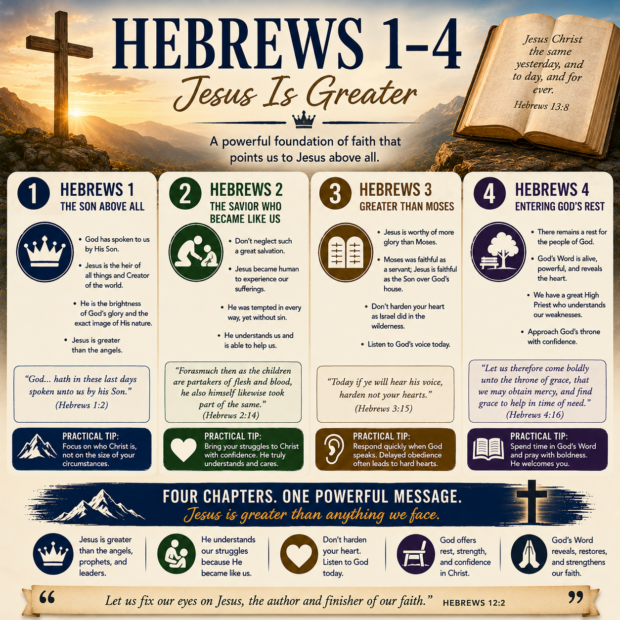
Hebrews 1–4 lays the foundation for the entire book. It presents Christ as superior to angels, greater than Moses, and the source of true rest for God’s people.
Think of these chapters as a mountain peak rising above every other hill. No matter how impressive previous leaders, prophets, or systems may have been, Jesus stands above them all.
Let’s explore these powerful opening chapters.
Hebrews 1: The Son Above All
Who is Jesus?
The writer begins with one of the most majestic descriptions of Christ found anywhere in Scripture.
“God… hath in these last days spoken unto us by his Son.” (Hebrews 1:2, KJV)
Jesus is presented as the heir of all things, the Creator of the world, and the exact image of God’s nature.
“Who being the brightness of his glory, and the express image of his person…” (Hebrews 1:3, KJV)
The chapter then demonstrates that Christ is greater than the angels. While angels are servants, Jesus is the eternal Son.
Research into leadership and influence consistently shows that authority carries greater weight when it comes from position and identity rather than mere function. Hebrews establishes Christ’s ultimate authority from the beginning.
As C.S. Lewis wrote, “Jesus Christ did not come into this world to make bad people good; He came to make dead people live.”
Practical Tip: When challenges arise, focus on who Christ is rather than the size of your circumstances.
Hebrews 2: The Savior Who Became Like Us
Why did Jesus become human?
The writer warns believers not to neglect the great salvation they have received.
“How shall we escape, if we neglect so great salvation?” (Hebrews 2:3, KJV)
Then comes a remarkable truth: Jesus willingly took on human nature.
“Forasmuch then as the children are partakers of flesh and blood, he also himself likewise took part of the same.” (Hebrews 2:14, KJV)
By becoming human, Jesus experienced suffering, temptation, and death. Yet He remained without sin.
Because He understands human weakness firsthand, He is able to help those who are struggling.
Studies in psychology show that people often trust those who genuinely understand their experiences. Jesus understands perfectly.
Billy Graham said, “God proved His love on the Cross. When Christ hung and bled and died, it was God saying to the world, ‘I love you.’”
Practical Tip: Bring your struggles to Christ with confidence. He understands your weaknesses and cares deeply for you.
Hebrews 3: Greater Than Moses
Why compare Jesus to Moses?
For Jewish believers, Moses was one of the greatest figures in history. He delivered God’s law and led Israel through the wilderness.
Yet Hebrews makes a bold statement:
“This man was counted worthy of more glory than Moses.” (Hebrews 3:3, KJV)
Moses was faithful as a servant in God’s house, but Christ is faithful as the Son over God’s house.
The writer then reminds readers of Israel’s failure in the wilderness. Despite witnessing God’s power, many hardened their hearts and failed to trust Him.
“Today if ye will hear his voice, harden not your hearts.” (Hebrews 3:15, KJV)
Behavioral research shows that repeated resistance to truth often leads to deeper resistance over time.
A.W. Tozer wrote, “A frightened world needs a fearless church.”
Practical Tip: Respond quickly when God speaks. Delayed obedience often leads to hardened hearts.
Hebrews 4: Entering God’s Rest
What kind of rest is God offering?
The promise of rest that Israel missed in the wilderness still remains available.
“There remaineth therefore a rest to the people of God.” (Hebrews 4:9, KJV)
This rest is not merely physical—it is spiritual confidence found through faith in God.
The chapter also highlights the power of Scripture:
“For the word of God is quick, and powerful, and sharper than any twoedged sword.” (Hebrews 4:12, KJV)
God’s Word penetrates deeply, revealing the true condition of the heart.
The chapter concludes with one of the most encouraging descriptions of Jesus:
“We have a great high priest… Jesus the Son of God.” (Hebrews 4:14, KJV)
Because He understands our weaknesses, believers can approach God’s throne boldly.
Research in stress management consistently shows that trust and confidence reduce anxiety and promote emotional stability. Hebrews points believers toward the ultimate source of confidence—Christ Himself.
Charles Spurgeon said, “Nobody ever outgrows Scripture; the Book widens and deepens with our years.”
Practical Tip: Spend regular time in God’s Word and approach Him confidently in prayer.
Conclusion: Looking to the Greater One
Hebrews 1–4 presents a powerful picture of Jesus Christ.
He is greater than the prophets.
Greater than the angels.
Greater than Moses.
Greater than every challenge we face.
We saw Christ’s divine authority.
We learned that He understands our struggles.
We were warned against hardening our hearts.
We discovered the promise of God’s rest.
The message is clear: when life becomes difficult, don’t look backward—look upward.
Jesus is enough.
May we trust Him fully, listen when He speaks, and rest confidently in His care.
Because the One who created all things, suffered for our salvation, and intercedes for us today is greater than anything we will ever face.