Have you ever wondered who stands between a holy God and imperfect people?
For centuries, Israel relied on priests to represent them before God. These priests offered sacrifices, interceded for the people, and served under the Old Covenant. Yet they were imperfect, temporary, and unable to fully remove sin.
In Hebrews 5–8, the focus shifts to one of the book’s most powerful themes: Jesus Christ as our Great High Priest. The writer reveals that Jesus is not simply another priest—He is the perfect and eternal High Priest who accomplished what no earthly priest could ever achieve.
Think of these chapters as a bridge connecting humanity to God, with Christ standing firmly in the middle as the perfect mediator.
Let’s explore this remarkable section of Hebrews.
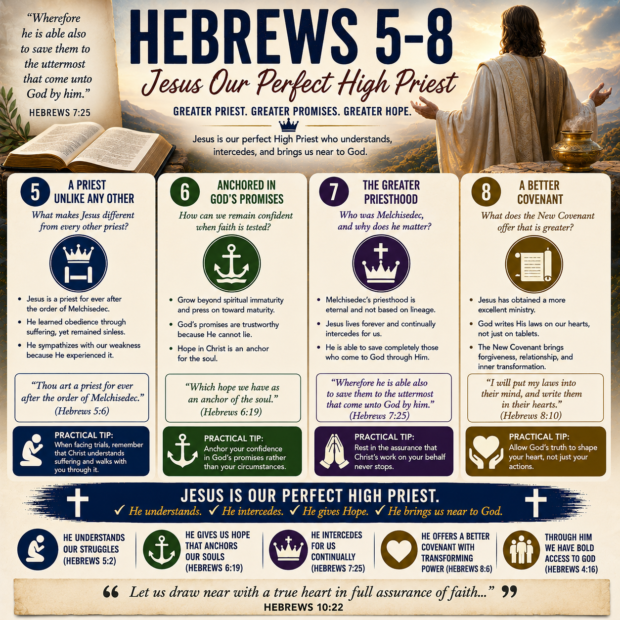
Hebrews 5: A Priest Unlike Any Other
What makes Jesus different from every other priest?
The writer explains that earthly high priests were chosen from among the people to represent them before God.
Yet Jesus’ priesthood is unique.
“Thou art a priest for ever after the order of Melchisedec.” (Hebrews 5:6, KJV)
Unlike the Levitical priests, Jesus’ priesthood is eternal.
The chapter also highlights Christ’s obedience:
“Though he were a Son, yet learned he obedience by the things which he suffered.” (Hebrews 5:8, KJV)
Through His suffering, Jesus fully identified with humanity while remaining sinless.
Studies in leadership consistently show that people trust leaders who understand hardship firsthand. Jesus not only understands suffering—He experienced it.
As Charles Spurgeon said, “Jesus is a brother born for adversity.”
Practical Tip: When facing trials, remember that Christ understands suffering and walks with you through it.
Hebrews 6: Anchored in God’s Promises
How can believers remain confident when faith is tested?
The writer urges believers to move beyond spiritual immaturity and continue growing in faith.
“Let us go on unto perfection.” (Hebrews 6:1, KJV)
After issuing a serious warning against falling away, he shifts to encouragement and assurance.
God’s promises are trustworthy because His character never changes.
“It was impossible for God to lie.” (Hebrews 6:18, KJV)
Then comes one of the most beautiful images in Hebrews:
“Which hope we have as an anchor of the soul.” (Hebrews 6:19, KJV)
Just as an anchor stabilizes a ship during a storm, hope in Christ steadies believers during life’s uncertainties.
Research in resilience psychology shows that people who possess a secure source of hope navigate adversity more effectively.
Corrie ten Boom said, “Hold everything in your hands lightly, otherwise it hurts when God pries your fingers open.”
Practical Tip: Anchor your confidence in God’s promises rather than your circumstances.
Hebrews 7: The Greater Priesthood
Who was Melchisedec, and why does he matter?
Hebrews 7 expands on the mysterious figure of Melchisedec, first mentioned in Genesis.
Unlike the Levitical priests, Melchisedec appears without recorded genealogy or succession, making him a fitting picture of Christ’s eternal priesthood.
The writer explains:
“This Melchisedec, king of Salem, priest of the most high God…” (Hebrews 7:1, KJV)
Jesus serves as a priest forever, not because of family lineage, but because of His eternal life.
“Wherefore he is able also to save them to the uttermost that come unto God by him.” (Hebrews 7:25, KJV)
Unlike earthly priests who died and had to be replaced, Jesus lives forever and continually intercedes for His people.
Studies in trust and reliability show that consistency builds confidence. Christ’s eternal nature provides believers with perfect security.
A.W. Tozer wrote, “Because God knows all things perfectly, He knows no thing better than any other thing.”
Practical Tip: Rest in the assurance that Christ’s work on your behalf never stops.
Hebrews 8: A Better Covenant
What if God’s plan offered something greater than the old system?
Hebrews 8 introduces the New Covenant.
The Old Covenant revealed God’s standards, but it could not fully transform the human heart.
Jesus established something better.
“Now hath he obtained a more excellent ministry.” (Hebrews 8:6, KJV)
The writer quotes God’s promise from Jeremiah:
“I will put my laws into their mind, and write them in their hearts.” (Hebrews 8:10, KJV)
The New Covenant is not merely external obedience—it is internal transformation.
God promises forgiveness, relationship, and spiritual renewal through Christ.
Modern behavioral research confirms that lasting change occurs when transformation happens internally rather than through external pressure alone.
John Stott said, “The essence of Christianity is not imitation but participation.”
Practical Tip: Allow God’s truth to shape your heart, not just your actions.
Conclusion: The High Priest We Needed
Hebrews 5–8 reveals the greatness of Jesus in a profound way.
We saw His compassion through suffering.
We discovered hope as an anchor for the soul.
We learned about His eternal priesthood.
We embraced the promises of a better covenant.
The message is clear: Jesus is the perfect High Priest.
He understands our struggles.
He intercedes on our behalf.
He offers lasting hope.
He provides complete access to God.
Unlike every earthly system that came before Him, Christ’s work is complete, eternal, and sufficient.
May we place our confidence fully in Him, anchor our lives in His promises, and rejoice in the privilege of drawing near to God through our perfect High Priest.
Because the One who represents us before the Father never fails, never changes, and never stops interceding for His people.