What if the sacrifices, rituals, and ceremonies of the Old Testament were all pointing to something greater?
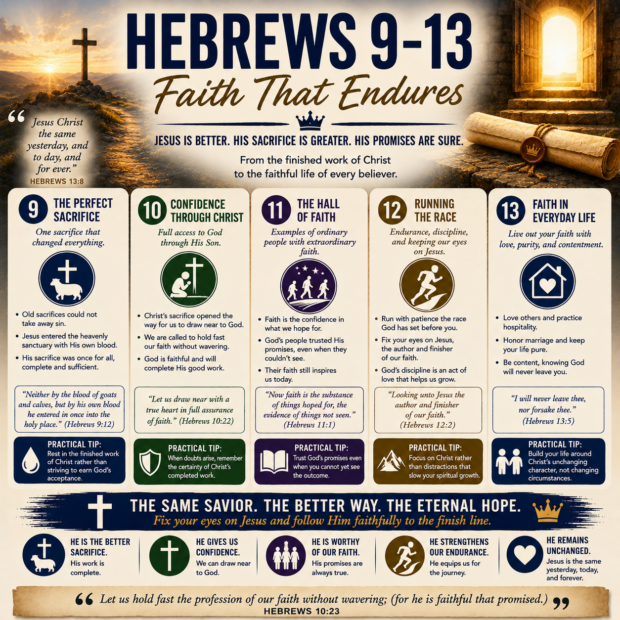
Hebrews 9–13 brings the book to a powerful conclusion. The writer reveals how Jesus fulfilled everything the Old Covenant foreshadowed and then challenges believers to live lives of faith, endurance, worship, and obedience.
These chapters move from the finished work of Christ to the practical response of every believer.
Think of Hebrews 9–13 as the final act of a grand story. The shadows give way to reality. The promises find fulfillment. And faith becomes the pathway for daily living.
Let’s explore this inspiring conclusion.
Hebrews 9: The Perfect Sacrifice
Can one sacrifice truly change everything?
The writer describes the earthly tabernacle and the sacrificial system established under the Old Covenant. Year after year, sacrifices were offered, but they could never fully remove sin.
Then comes the contrast:
“But Christ being come an high priest of good things to come…” (Hebrews 9:11, KJV)
Unlike animal sacrifices, Jesus entered the heavenly sanctuary with His own blood.
“Neither by the blood of goats and calves, but by his own blood he entered in once into the holy place.” (Hebrews 9:12, KJV)
His sacrifice was complete, final, and sufficient.
Studies in conflict resolution show that true reconciliation requires addressing the root problem. Christ dealt with sin at its source.
Charles Spurgeon said, “There is more power in Christ’s blood to save than there is in sin to destroy.”
Practical Tip: Rest in the finished work of Christ rather than striving to earn God’s acceptance.
Hebrews 10: Confidence Through Christ
How can imperfect people approach a holy God?
Because of Christ’s sacrifice, believers have direct access to God.
“Let us draw near with a true heart in full assurance of faith.” (Hebrews 10:22, KJV)
The repeated sacrifices of the Old Covenant have ended because Jesus offered Himself once and for all.
The chapter also contains a strong warning against abandoning faith and a call to perseverance.
“Let us hold fast the profession of our faith without wavering.” (Hebrews 10:23, KJV)
Psychological studies show that commitment grows stronger when people maintain focus on long-term purpose rather than temporary challenges.
Billy Graham said, “The will of God will not take us where the grace of God cannot sustain us.”
Practical Tip: When doubts arise, remember the certainty of Christ’s completed work.
Hebrews 11: The Hall of Faith
What does genuine faith look like?
Hebrews 11 provides one of the Bible’s most beloved chapters—a gallery of faithful men and women who trusted God.
It begins with the famous definition:
“Now faith is the substance of things hoped for, the evidence of things not seen.” (Hebrews 11:1, KJV)
Abel, Noah, Abraham, Sarah, Moses, and many others are highlighted for their trust in God despite uncertainty.
They did not always see immediate results, but they remained faithful.
Research in resilience psychology consistently shows that hope and conviction help people persevere through challenges.
Martin Luther said, “Faith is a living, daring confidence in God’s grace.”
Practical Tip: Trust God’s promises even when you cannot yet see the outcome.
Hebrews 12: Running the Race
How do believers remain faithful over the long journey?
The writer compares the Christian life to a race.
“Let us run with patience the race that is set before us.” (Hebrews 12:1, KJV)
The key is keeping our eyes fixed on Christ:
“Looking unto Jesus the author and finisher of our faith.” (Hebrews 12:2, KJV)
The chapter also discusses God’s loving discipline, which helps believers grow in maturity.
Athletic research confirms that endurance develops through consistent training and perseverance.
Oswald Chambers wrote, “Faith never knows where it is being led, but it loves and knows the One who is leading.”
Practical Tip: Focus on Christ rather than distractions that slow your spiritual growth.
Hebrews 13: Faith in Everyday Life
What does faith look like in daily living?
The final chapter becomes intensely practical.
The writer encourages believers to love others, show hospitality, care for those who suffer, honor marriage, avoid greed, and remain faithful.
“Let your conversation be without covetousness; and be content with such things as ye have.” (Hebrews 13:5, KJV)
Then comes one of the most comforting promises in Scripture:
“I will never leave thee, nor forsake thee.” (Hebrews 13:5, KJV)
And one of the most famous declarations:
“Jesus Christ the same yesterday, and to day, and for ever.” (Hebrews 13:8, KJV)
In a constantly changing world, Christ remains unchanged.
Studies on emotional stability consistently show that people thrive when anchored to dependable truths and relationships.
A.W. Tozer said, “What comes into our minds when we think about God is the most important thing about us.”
Practical Tip: Build your life around Christ’s unchanging character rather than changing circumstances.
Conclusion: The Better Way
Hebrews 9–13 brings the book’s message to its glorious conclusion.
We saw Christ’s perfect sacrifice.
We gained confidence through His finished work.
We learned from the examples of faith.
We ran the race with endurance.
We discovered practical ways to live faithfully.
The message of Hebrews is simple yet profound: Jesus is better.
He is the better sacrifice.
The better priest.
The better covenant.
The better hope.
And because of Him, believers can approach God with confidence, endure hardships with faith, and live each day with purpose.
May we fix our eyes on Jesus, trust His promises, and follow Him faithfully to the finish line.
Because the same Savior who opened the way to God is the One who will carry us safely home.