What kind of legacy are you leaving through your actions and influence?
The Book of 3 John is one of the shortest books in the Bible, yet it delivers a powerful message about faithfulness, hospitality, leadership, and Christian character. Written by the Apostle John, this brief letter highlights three individuals whose lives provide valuable lessons for believers today.
One man is praised for his faithfulness. Another is rebuked for his pride. A third is commended for his godly reputation.
Think of 3 John as a mirror that asks an important question: Which example are we following?
Though only one chapter long, this letter offers timeless wisdom about serving others and walking in truth.
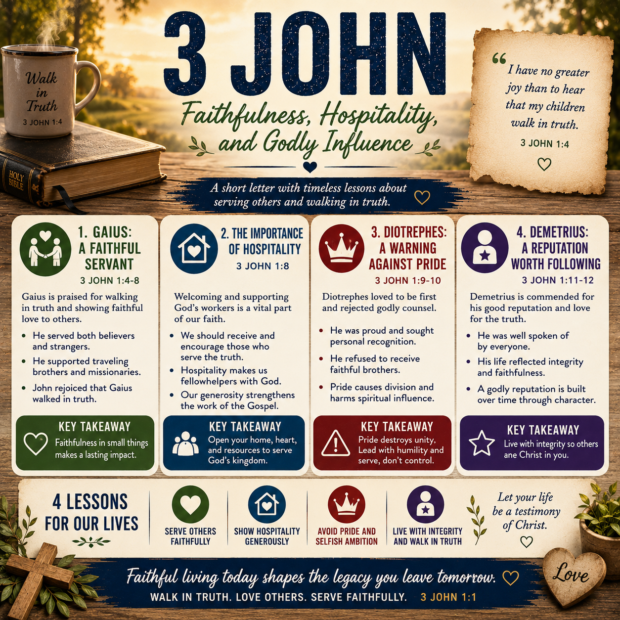
Gaius: A Faithful Servant
What does it mean to live faithfully?
John begins by addressing Gaius, a believer known for his commitment to truth and hospitality.
“Beloved, thou doest faithfully whatsoever thou doest to the brethren, and to strangers.” (3 John 1:5, KJV)
Gaius was not famous for wealth, power, or position. He was known for faithfully serving God’s people.
John expresses great joy because Gaius was walking in truth.
“I have no greater joy than to hear that my children walk in truth.” (3 John 1:4, KJV)
Faithfulness often reveals itself through ordinary acts of kindness and obedience.
Research in leadership and character development consistently shows that trust is built through consistent actions over time rather than occasional achievements.
Billy Graham said, “The highest form of worship is the worship of unselfish Christian service.”
Practical Tip: Look for opportunities to serve others faithfully, even when no recognition is expected.
The Importance of Hospitality
Why does hospitality matter so much?
John praises Gaius for supporting traveling Christian workers and welcoming fellow believers.
In the early church, missionaries and teachers often depended on the hospitality of faithful Christians.
John encourages believers to support those who spread the Gospel.
“We therefore ought to receive such, that we might be fellowhelpers to the truth.” (3 John 1:8, KJV)
Hospitality is more than opening a home—it is opening our lives to encourage and strengthen others.
Studies on community and relationships consistently show that generosity and hospitality build stronger connections and greater well-being.
Mother Teresa said, “Spread love everywhere you go. Let no one ever come to you without leaving happier.”
Practical Tip: Use your resources, time, and encouragement to support those serving God faithfully.
Diotrephes: A Warning Against Pride
How can pride damage spiritual influence?
John contrasts Gaius with a man named Diotrephes.
“Diotrephes, who loveth to have the preeminence among them.” (3 John 1:9, KJV)
Rather than serving others, Diotrephes sought personal recognition and authority.
His pride led him to reject godly counsel, create division, and mistreat fellow believers.
This serves as a warning that leadership without humility can become harmful.
Research in organizational leadership consistently identifies pride and self-centeredness as major causes of ineffective leadership.
C.S. Lewis wrote, “Pride gets no pleasure out of having something, only out of having more of it than the next man.”
Practical Tip: Focus on serving others rather than seeking recognition or control.
Demetrius: A Reputation Worth Following
What kind of reputation should believers pursue?
John concludes by commending Demetrius.
“Demetrius hath good report of all men, and of the truth itself.” (3 John 1:12, KJV)
His life reflected both integrity and faithfulness.
A good reputation is not built through image management but through consistent character.
People trusted Demetrius because his actions matched his beliefs.
Studies in personal influence show that credibility grows when character and behavior remain consistent over time.
John Maxwell said, “A good leader is a person who takes a little more than his share of the blame and a little less than his share of the credit.”
Practical Tip: Build a reputation based on honesty, humility, and faithfulness.
Walking in Truth Every Day
Why does John emphasize truth so often?
Throughout this short letter, truth remains a central theme.
For John, truth was not merely something to believe—it was something to live.
Walking in truth means allowing God’s Word to guide our choices, relationships, and priorities.
It affects how we serve others, how we lead, and how we respond to challenges.
Research in personal development shows that people experience greater fulfillment when their actions align with their values.
A.W. Tozer said, “Truth is not something we create; it is something we discover.”
Practical Tip: Let God’s truth shape your daily decisions and interactions.
Conclusion: The Legacy of a Faithful Life
The Book of 3 John may be brief, but its lessons are powerful.
We learned from the faithfulness of Gaius.
We saw the importance of hospitality.
We were warned by the example of Diotrephes.
We were encouraged by the character of Demetrius.
We discovered the importance of walking in truth.
John’s message is clear: character matters.
Faithfulness matters.
Humility matters.
Truth matters.
Every believer leaves a legacy through the way they live and influence others.
May we choose the example of Gaius and Demetrius rather than the pride of Diotrephes.
May we serve faithfully, love generously, and walk consistently in God’s truth.
Because a life devoted to Christ becomes a testimony that influences others long after we are gone.