What do believers do when truth is under attack?
The Book of Jude may be one of the shortest books in the Bible, but it carries a powerful and urgent message. Written during a time when false teachers were infiltrating the church, Jude calls believers to stand firm, defend the truth, and remain faithful to God.
Rather than writing about salvation alone, Jude felt compelled to address a growing danger that threatened the spiritual health of believers.
Think of Jude as a watchman standing on a city wall. Seeing danger approaching, he sounds the alarm—not to create fear, but to encourage vigilance and faithfulness.
Though only one chapter long, Jude offers timeless lessons about discernment, perseverance, and trusting God’s power.
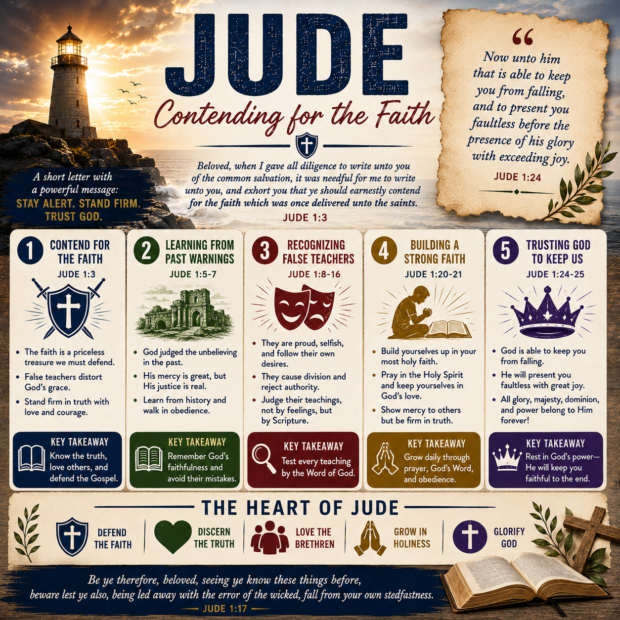
Contend for the Faith
Why is truth worth defending?
Jude begins by encouraging believers to actively protect the faith that has been entrusted to them.
“Ye should earnestly contend for the faith which was once delivered unto the saints.” (Jude 1:3, KJV)
The Gospel is not something that changes with culture or popular opinion. It is God’s truth, entrusted to His people.
Jude warns that certain individuals had secretly entered the church and were distorting God’s grace.
Believers are called to stand firm in biblical truth while maintaining humility and love.
Research in leadership and ethics consistently shows that strong values help individuals remain stable during times of confusion and pressure.
As A.W. Tozer said, “A frightened world needs a fearless church.”
Practical Tip: Know God’s Word well so you can recognize truth and identify error.
Learning from Past Warnings
Why does Jude remind readers of historical examples?
Jude points to several examples from Scripture where people experienced God’s judgment because of rebellion and unbelief.
These examples include the Israelites who doubted God, fallen angels who abandoned their position, and the cities of Sodom and Gomorrah.
The lesson is clear:
God is patient and merciful, but He also takes sin seriously.
“The Lord, having saved the people out of the land of Egypt, afterward destroyed them that believed not.” (Jude 1:5, KJV)
History provides valuable lessons for future generations.
Studies in behavioral science show that learning from past mistakes helps people avoid repeating destructive patterns.
Charles Spurgeon said, “Wisdom is the right use of knowledge.”
Practical Tip: Learn from biblical examples and allow their lessons to strengthen your faith and obedience.
Recognizing False Teachers
How can believers identify spiritual deception?
Jude describes false teachers as individuals who reject authority, pursue selfish desires, and lead others away from God’s truth.
They may appear convincing outwardly, but their lives reveal their true character.
“These are murmurers, complainers, walking after their own lusts.” (Jude 1:16, KJV)
Jude uses vivid illustrations to show that appearances can be misleading.
Throughout church history, discernment has been essential for protecting the church from harmful teaching.
Research in critical thinking demonstrates that evaluating claims carefully helps people avoid manipulation and deception.
C.S. Lewis wrote, “The safest road to hell is the gradual one—the gentle slope, soft underfoot, without sudden turnings.”
Practical Tip: Evaluate teachings by comparing them with Scripture rather than relying on popularity or personality.
Building a Strong Faith
How can believers remain spiritually strong?
After warning about deception, Jude shifts to encouragement.
Rather than focusing solely on false teachers, he tells believers how to grow stronger.
“But ye, beloved, building up yourselves on your most holy faith, praying in the Holy Ghost.” (Jude 1:20, KJV)
Spiritual strength develops through prayer, Scripture, fellowship, and dependence on God.
Jude also encourages believers to remain in God’s love and look forward to Christ’s mercy.
Studies on resilience consistently show that people who maintain strong spiritual practices often demonstrate greater perseverance during challenges.
Billy Graham said, “The Christian life is not a constant high, but God gives strength for every season.”
Practical Tip: Invest daily in prayer and Bible study to strengthen your faith.
Trusting God’s Power to Keep Us
Can believers remain secure in a world filled with challenges?
Jude concludes with one of the most encouraging passages in Scripture.
“Now unto him that is able to keep you from falling.” (Jude 1:24, KJV)
While believers are called to remain vigilant, their ultimate security rests in God’s power.
The Christian life is not sustained by human strength alone but by God’s faithfulness.
Jude ends with praise and worship, reminding believers that God is worthy of all glory, majesty, power, and authority.
Research in hope and spirituality consistently finds that confidence in a trustworthy source provides greater emotional strength and perseverance.
Corrie ten Boom said, “Never be afraid to trust an unknown future to a known God.”
Practical Tip: Place your confidence in God’s ability to sustain and guide you through every challenge.
Conclusion: Standing Firm Until the End
The Book of Jude delivers a timely message for every generation.
We learned the importance of contending for the faith.
We saw warnings from biblical history.
We discovered how to recognize false teaching.
We learned how to strengthen our faith.
We found confidence in God’s power to keep us secure.
Jude’s message is clear: remain faithful, stay alert, and trust God.
Truth is worth defending.
Faith is worth protecting.
God is worthy of our trust.
May we stand firmly on God’s Word, grow stronger in our relationship with Christ, and remain faithful no matter what challenges arise.
Because the God who calls His people to faithfulness is also the God who is able to keep them, strengthen them, and present them faultless before His glory with exceeding joy.