What would you do if you suddenly caught a glimpse of heaven itself?
The Book of Revelation is often viewed as mysterious and difficult to understand. Yet its opening chapters begin with a message of hope, worship, and assurance. Before revealing future events and judgments, God first directs our attention to Jesus Christ—His glory, His authority, and His eternal reign.
Revelation 1–5 reminds believers that no matter how uncertain the world may seem, Christ is in control. He walks among His people, knows their struggles, and reigns from heaven’s throne.
Think of these chapters as the opening scene of a great drama. Before the events of the end times unfold, the curtain pulls back to reveal the King of kings seated upon His throne.
Let’s explore this remarkable beginning to the final book of the Bible.
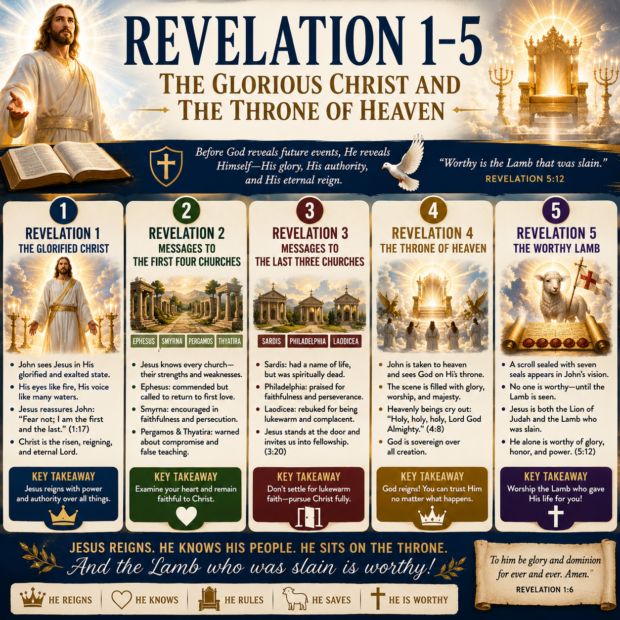
Revelation 1: The Glorified Christ
Who is Jesus right now?
The book opens with a powerful declaration:
“The Revelation of Jesus Christ, which God gave unto him.” (Revelation 1:1, KJV)
John, exiled on the island of Patmos, receives a vision unlike anything he has ever seen.
He sees Jesus in His glorified and exalted state.
“His eyes were as a flame of fire.” (Revelation 1:14, KJV)
“His voice as the sound of many waters.” (Revelation 1:15, KJV)
The sight is so overwhelming that John falls at His feet.
Yet Jesus offers comfort:
“Fear not; I am the first and the last.” (Revelation 1:17, KJV)
Christ is not merely a figure from history. He is the risen, reigning, and eternal Lord.
Studies on resilience consistently show that people experience greater peace when they trust in something stable and unchanging. Revelation begins by reminding believers that Christ remains sovereign over all things.
Billy Graham said, “The will of God will not take us where the grace of God cannot sustain us.”
Practical Tip: When life feels uncertain, remember that Jesus reigns with power and authority.
Revelation 2: Messages to the First Four Churches
How does Christ view His church?
Jesus addresses the churches of Ephesus, Smyrna, Pergamos, and Thyatira.
Each church receives encouragement, correction, or both.
The church at Ephesus was commended for hard work and doctrinal faithfulness, yet Jesus said:
“Thou hast left thy first love.” (Revelation 2:4, KJV)
Smyrna was encouraged to remain faithful despite persecution.
Pergamos was warned about compromise.
Thyatira was rebuked for tolerating false teaching.
These messages remind believers that Christ knows every strength and every weakness within His people.
Research on organizational health consistently shows that success requires both recognizing strengths and addressing weaknesses honestly.
A.W. Tozer wrote, “God never uses anyone greatly until He tests them deeply.”
Practical Tip: Regularly examine your spiritual life and ask whether your love for Christ remains strong.
Revelation 3: Messages to the Last Three Churches
What does spiritual complacency look like?
Jesus continues His messages to Sardis, Philadelphia, and Laodicea.
Sardis had a reputation for being spiritually alive, yet Christ declared:
“Thou hast a name that thou livest, and art dead.” (Revelation 3:1, KJV)
Philadelphia was praised for remaining faithful despite limited strength.
Laodicea received one of Scripture’s strongest rebukes:
“Because thou art lukewarm, and neither cold nor hot, I will spue thee out of my mouth.” (Revelation 3:16, KJV)
Yet even in correction, Christ offers hope.
“Behold, I stand at the door, and knock.” (Revelation 3:20, KJV)
Jesus desires fellowship with His people.
Research in personal growth consistently shows that self-awareness and willingness to change are essential for healthy development.
Charles Spurgeon said, “A little faith will bring your soul to heaven; a great faith will bring heaven to your soul.”
Practical Tip: Don’t settle for spiritual routine. Pursue a vibrant and growing relationship with Christ.
Revelation 4: The Throne of Heaven
Who truly rules the universe?
John’s attention shifts from earth to heaven.
The first thing he sees is a throne.
“And, behold, a throne was set in heaven, and one sat on the throne.” (Revelation 4:2, KJV)
The scene is filled with worship, majesty, and glory.
Twenty-four elders and four living creatures continually praise God:
“Holy, holy, holy, Lord God Almighty.” (Revelation 4:8, KJV)
Before any judgments unfold, believers are reminded that God remains firmly seated on His throne.
Nothing is outside His control.
Studies on anxiety consistently reveal that confidence grows when people trust in something greater than themselves.
Corrie ten Boom said, “There is no panic in Heaven. God has no problems, only plans.”
Practical Tip: When circumstances feel overwhelming, remember that God still reigns.
Revelation 5: The Worthy Lamb
Who is worthy to accomplish God’s purposes?
John sees a scroll sealed with seven seals.
A mighty angel asks:
“Who is worthy to open the book?” (Revelation 5:2, KJV)
At first, no one is found worthy, and John begins to weep.
Then comes one of the most beautiful moments in Scripture:
“Behold, the Lion of the tribe of Juda.” (Revelation 5:5, KJV)
Yet when John looks, he sees:
“A Lamb as it had been slain.” (Revelation 5:6, KJV)
Jesus is both the conquering Lion and the sacrificial Lamb.
All heaven erupts in worship:
“Worthy is the Lamb that was slain.” (Revelation 5:12, KJV)
The entire universe joins in praise because Christ alone is worthy.
Studies on gratitude and worship show that focusing on something greater than ourselves often produces hope, perspective, and renewed strength.
John Stott wrote, “The essence of sin is man substituting himself for God, while the essence of salvation is God substituting Himself for man.”
Practical Tip: Make worship a regular part of your life by focusing on who Christ is and what He has done.
Conclusion: Fixing Our Eyes on the King
Revelation 1–5 opens with a breathtaking picture of Jesus Christ and the glory of heaven.
We saw the risen and glorified Christ.
We heard His messages to the churches.
We stood before heaven’s throne.
We joined in worship of the worthy Lamb.
The message is clear: Jesus reigns.
He knows His church.
He sees every struggle.
He sits upon the throne.
And He alone is worthy of all worship.
Before Revelation speaks of judgments, battles, and future events, it first reminds believers of the most important truth:
The Lamb is on the throne.
May we remain faithful, keep our love for Christ strong, and worship Him with confidence and hope.
Because no matter what happens in the world around us, the King of kings reigns forever, and the Lamb who was slain is worthy of all honor, glory, and praise.