What does genuine faith look like when life gets difficult?
The Book of James is one of the most practical books in the entire Bible. While many New Testament letters focus heavily on doctrine, James focuses on daily living. He challenges believers to move beyond simply hearing God’s Word and begin putting it into practice.
Think of James as a spiritual mirror. It doesn’t just tell us what faith is—it shows us what faith should look like in everyday life.
Across five chapters, James addresses trials, wisdom, speech, humility, patience, prayer, and the connection between faith and action.
Let’s explore this powerful guide to authentic Christian living.
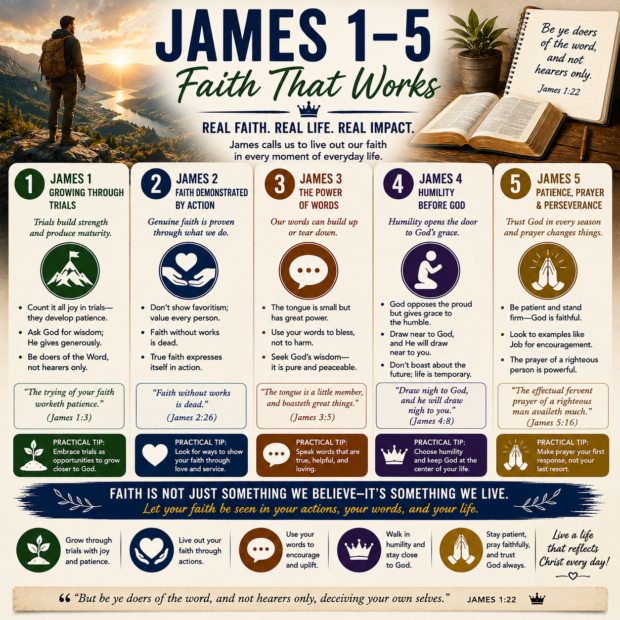
James 1: Growing Through Trials
Can difficult seasons actually strengthen your faith?
James opens with a surprising command:
“Count it all joy when ye fall into divers temptations.” (James 1:2, KJV)
He is not saying trials are enjoyable. Rather, trials produce spiritual growth, endurance, and maturity.
“The trying of your faith worketh patience.” (James 1:3, KJV)
James also encourages believers to seek wisdom from God.
“If any of you lack wisdom, let him ask of God.” (James 1:5, KJV)
The chapter then emphasizes the importance of obeying God’s Word rather than merely hearing it.
“Be ye doers of the word, and not hearers only.” (James 1:22, KJV)
Studies in resilience psychology show that challenges often become opportunities for growth when approached with purpose and perspective.
As Corrie ten Boom said, “There is no pit so deep that God’s love is not deeper still.”
Practical Tip: Instead of asking why a trial is happening, ask what God may be teaching through it.
James 2: Faith Demonstrated by Action
Can faith exist without action?
James addresses favoritism within the church and reminds believers that every person deserves dignity and respect.
He then presents one of the book’s most well-known teachings:
“Faith without works is dead.” (James 2:26, KJV)
James is not teaching salvation by works. Rather, he explains that genuine faith naturally produces visible evidence.
Abraham and Rahab are presented as examples of faith expressed through action.
Behavioral research consistently shows that beliefs are most meaningful when reflected in daily behavior.
Billy Graham said, “Faith is taking the first step even when you don’t see the whole staircase.”
Practical Tip: Let your actions reflect the faith you profess.
James 3: The Power of Words
How much influence do our words really have?
James compares the tongue to a small spark capable of starting a great fire.
“The tongue is a little member, and boasteth great things.” (James 3:5, KJV)
Words can build up or tear down, encourage or discourage, heal or wound.
James also contrasts earthly wisdom with heavenly wisdom.
“The wisdom that is from above is first pure, then peaceable.” (James 3:17, KJV)
Communication studies consistently show that words significantly shape relationships, leadership, and personal influence.
Mother Teresa said, “Kind words can be short and easy to speak, but their echoes are truly endless.”
Practical Tip: Before speaking, ask whether your words are true, helpful, and loving.
James 4: Humility Before God
What causes conflict and spiritual drift?
James points to pride, selfish desires, and friendship with worldly values.
“God resisteth the proud, but giveth grace unto the humble.” (James 4:6, KJV)
One of the most powerful invitations in Scripture follows:
“Draw nigh to God, and he will draw nigh to you.” (James 4:8, KJV)
James also reminds believers not to boast about the future, since life is temporary.
“For what is your life? It is even a vapour.” (James 4:14, KJV)
Research in leadership and emotional intelligence consistently identifies humility as a key trait of effective and respected individuals.
C.S. Lewis wrote, “Humility is not thinking less of yourself; it is thinking of yourself less.”
Practical Tip: Approach God daily with humility and dependence rather than self-sufficiency.
James 5: Patience, Prayer, and Perseverance
How should believers respond when life becomes difficult?
James encourages patience during suffering and reminds believers that God is faithful.
“Be ye also patient; stablish your hearts.” (James 5:8, KJV)
He points to Job as an example of endurance and faithfulness through hardship.
The chapter concludes with one of the Bible’s strongest teachings on prayer:
“The effectual fervent prayer of a righteous man availeth much.” (James 5:16, KJV)
Elijah is presented as an example of how God responds to sincere prayer.
Studies on spirituality and mental health show that prayer often provides comfort, hope, and emotional resilience during difficult times.
A.W. Tozer said, “Prayer is an offering of worship that places us in God’s presence.”
Practical Tip: Make prayer your first response rather than your last resort.
Conclusion: Faith in Action
James 1–5 challenges believers to move beyond merely talking about faith and begin living it.
We learned to grow through trials.
We discovered that faith produces action.
We saw the power of our words.
We embraced humility before God.
We practiced patience, perseverance, and prayer.
The message of James is clear: genuine faith changes the way we live.
It affects our actions.
Our speech.
Our relationships.
Our attitudes.
And our response to life’s challenges.
May we not simply hear God’s Word but live it daily.
Because faith is not measured by what we say we believe—it is revealed by how we live.
And when faith becomes visible through action, the world sees the transforming power of God at work in our lives.